From the category archives:

In the News

You can read about Winston Churchill’s career elsewhere. I’d like rather to indulge in the remembrance of a friend.

We met through the post forty-two years ago, when he became the third honorary member of the Churchill Study Unit, after his grandmother and his father. The latter had only just sent a letter of encouragement to our little group of stamp collectors when he himself died. It was June, 1968. In sending condolences, I asked him to take his father’s place. He accepted, adding, “It is consoling to know so many share my loss.”

And for four decades “Young Winston” was a stalwart supporter, friend and a collaborator on projects too numerous to recount. While kidding him that he was fast getting to be the “Not-So-Young Winston,” I felt he was timeless, always there for us: encouraging, prodding, donating, participating. My grief at his loss, far too soon, is deeply felt.

He gave us permission to publish his grandfather’s articles and speeches in Finest Hour. He appeared for speeches and presentations, from conferences to our Churchill Tours of England. He officiated at joint ceremonies like the commissioning of USS Winston S. Churchill, the American Veterans Center, our 2006 Churchill Lecture. When we founded The Churchill Centre in 1995, he was among the first to contribute to its endowment. He freely allowed his signature to be used on solicitations, most recently in a letter asking lapsed members to renew, which, eerily, was received by some after his death.

Like his father, he preferred to communicate by telephone, announcing himself with a cheery “Winston here!” He would call to tell of his adventures, from flying desperate medical missions for St. John Ambulance Air Wing to exploring scenes of his grandfather’s exploits—like the Malakand Pass, where he rode in an armoured car accompanied by soldiers armed to the teeth. Truly, he lived life large. In London and Washington, he knew everybody, just like his mother. As they said of Alistair Cooke: “He could reach back, reach forward, and make the connections. He was always, triumphantly, in touch.”

On one of his trips to New England, when promoting his book of Sir Winston’s writings about America, The Great Republic, we took him to visit Plimoth Plantation. There he accosted an Indian, assuring him they were related, “since my grandfather was part-Iroquois.” Back in the car I let him have it: “Winston, you’re as Iroquois as my cat!” “If you’re so smart,” he said, “prove it. Meanwhile it’s my story and I’m running with it!”

When I first visited him in London, he showed me his personal memorabilia. Here was the peerless Orpen portrait of his sad grandfather after the Dardanelles; an ornamental table once owned by John Churchill First Duke of Marlborough; a collection of WSC’s works, all first editions inscribed by his grandfather. I was a Churchill bookseller at the time, and he wanted to know what I thought of his collection. “Well,” I said, “you’ve made a start…..”

We had several literary collaborations. When he assembled Never Give In!, his collection of Sir Winston’s best speeches, I was able to dig out some obscure ones he needed, like his grandfather’s remarks in Durban after escaping from the Boers in 1899. His writings appeared in Finest Hour, most recently in recounting the heroic contributions of Poles in World War II, in issue 145.

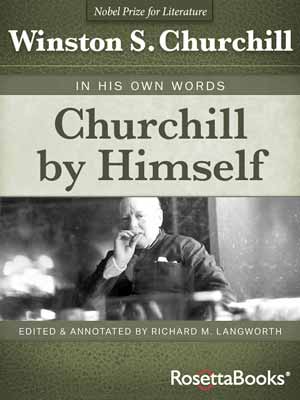
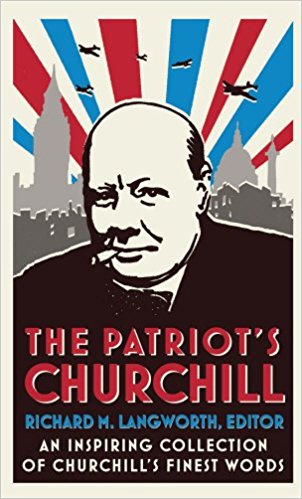
Our largest “combined operation” was Churchill By Himself, the book I couldn’t have produced without his permission. Winston provided his grandfather’s words, I provided editorial notes. This, I assured him, would be “a production to rival South Pacific: music by W. Churchill, lyrics by R. Langworth.”

There were amusing adventures, like his call for “cigar quotes” for a company producing a new Churchill corona. I supplied the quotes and he asked if I wanted to be paid. “Yes,” I said, “with a box of cigars.” Sniffed Winston: “I don’t touch the dreadful things myself, but there’s no reason you shouldn’t kill yourself if you wish.” The box duly arrived with the price still on it, and I was temporarily elevated to smoking a twenty-five dollar corona, courtesy of my friend in London. (Recently I gave one to a Bahamian pal, its elaborate band sparkling with a red and gilt Churchill coat of arms. He looked as if he’d received a knighthood.)

Political labels are all too freely applied, and some labeled Winston a right-winger, but his views were too complex to be pigeonholed. True, he broke with Mrs. Thatcher by voting against sanctions on Rhodesia; he deplored the skinning-down of Britain’s armed forces; he worried publicly over unrestricted Commonwealth immigration and the muslimization of his country. But he was also pro-Europe; he strove for a more classless society. And last year, when Barack Obama’s Cairo speech was regarded by the right as a surrender, Winston hailed it as a courageous breakthrough in American foreign policy.

It is too easy to compare him to his grandfather and lament that he (or his father) were not equally great. Who was? It is most awfully untrue “that no acorn grows under a mighty oak.” There are just as many progeny of the great who did better than their parents (beginning of course with Sir Winston himself). For every “Randolph” there was a “Winston”—among the Buckleys, the Chamberlains, the Kennedys, the Salisburys, the Roosevelts, the Rothschilds, ad infinitum. It’s simply wrong to imply on this basis that his life was futile. Ultimately, most lives are.

And it is gratuitous to compare him to his female relations, since in those years, women were expected to mind their own business and perpetuate the family. The Churchill women who exceeded those roles did so through their own talent and character. Much more was expected of the Churchill men—more, perhaps, than could be expected of anyone. The onus was upon them both: Randolph, only son of Winston; Winston, only son of Randolph.

Still, with their pens, Winston and his father could reach heights matched by few. Were they great journalists? Read Randolph’s first two volumes on his father; read Winston’s biography of Randolph; read their joint book on the 1967 Arab-Israeli Six-Day War. The question answers itself.

Concerning his grandfather, Finest Hour once quoted Shakespeare’s Malvolio: “Some men are born great, some achieve greatness, and some have greatness thrust upon them.” Winston was one of those whom some tried to thrust greatness upon. He shook it off by being himself—not what some thought he was obliged to be.

His record was one on which I think he was content to be judged. Having no doubt about the verdict, it seems appropriate to conclude with another quote, by Rossiter Raymond, which adorns the tombstone of  Parry Thomas, the great Welsh racing driver: “Life is eternal, and love is immortal, and death is only a horizon; and a horizon is nothing save the limit of our sight.”


{ 0 comments }

1943Vsign“A few curmudgeons have flamboyantly abstained from joining in this birthday greeting; but they are so few that their action merely emphasises the fact that personal respect and friendship habitually survive and transcend political conflict in the Mother of Parliaments. It is particularly appropriate that these all-party tributes on his birthday should be paid to one, the outstanding fact of whose character and career is that he has never been happier than when leading men of all parties and men of no party in some great national cause. He has never ceased to combine zeal for reform with reverence for tradition.

“And as in home affairs so in world affairs he has within him the stuff of which fertile cooperation is woven. The man to whom the Old World owes so much of its survival himself belongs by blood half to the New—he is, as has been neatly said, ‘half American and all English’—and this great citizen of an island realm has always had an unusual comprehension of Continental nations. Where he has loved them, he has marched loyally with them through dark hours. Where he has fought them, his hate has died with their surrender.

“Let us not forget that a birthday which has been made a national and indeed an international event is in its essence a family event. For half a century of sunshine and storm he has had in Lady Churchill as today, a stimulating and sensible companion, charming the magic casements of his life. Of all the birthday presents, none can be more precious than the sum of those years of undemanding and undeviating affection.

“He has some personal dislikes—which of us has not? He is the personal dislike of some—which of us is not? But on this day sinks the fever of all the emotions save those evoked by the knowledge that our mighty compatriot in his long journey has made himself the architect of imperishable achievements and the symbol of  inexpugnable courage.”

The Daily Telegraph, London, Tuesday, 30 November 1954


{ 0 comments }

Churchill on Healthcare

October 19, 2009

I am hoping you can place in context a statement by Winston Churchill, which has been offered to show that he would support current U.S. heath care reform proposals. My own Catholic parish recently published the aforementioned statement in its weekly bulletin.
What Would Winnie Do? Here’s an interesting quote. It’s from conservative British Prime Minister Winston [...]

Read the full article →

“Winston” Olbermann and the Healthcare Debate

October 19, 2009

N.B.: If Mr. Olbermann had done more research, he would know what Churchill did say about national healthcare, which is more to the point: see Churchill and Healthcare.
MSNBC commentator Keith Olbermann is for the proposed American healthcare reform bill, which is neither here nor there.
What is interesting to Churchillians is his use of Winston Churchill’s [...]

Read the full article →

The Un-great Non-debate

September 22, 2009

The Great Debate: “Resolved, that Winston Churchill was more a liability than an asset to the free world.” Sponsored by Intelligence Squared, viewable on C-Span.
LONDON, SEPT. 3RD— It was avidly awaited but fell flat. Tabling a truly ridiculous motion, Intelligence Squared (“the only institution in town aside from [...]

Read the full article →