“Democracy is the worst form of Government…”

Democracy is the worst form of government, except for all the others. “It is frequently claimed that Churchill said this (or words to that effect). I have tried to locate the source of that quote, but I have not been able to trace it. Is it genuine, and if so, where and when?” —D.C., Bogotá, Colombia
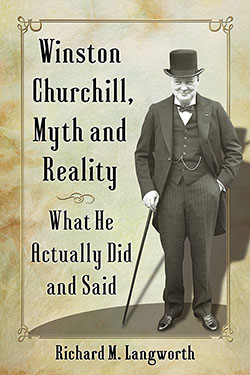
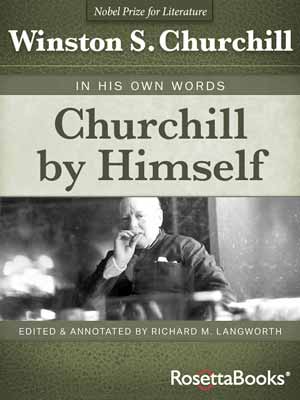
He said it (House of Commons, 11 November 1947)—but he was quoting an unknown predecessor. From Churchill by Himself, 574:
Many forms of Government have been tried, and will be tried in this world of sin and woe. No one pretends that democracy is perfect or all-wise. Indeed it has been said that democracy is the worst form of Government except for all those other forms that have been tried from time to time.…
So, although these are Churchill’s words, he clearly did not originate the famous remark about democracy. William F. Buckley, Jr., commenting on trickery in presidential debates, reminded us of Churchill’s reflection when he wrote in June 2007: “We are made to ask what it is that political democracy gives us. The system is utilitarian. But is it a fit object of faith and hope?” Credit Churchill as publicist for an unsourced aphorism.
Democracy: Churchillisms
But here are some original things (included in Churchill by Himself) that Churchill did say about democracy:
If I had to sum up the immediate future of democratic politics in a single word I should say “insurance.” That is the future—insurance against dangers from abroad, insurance against dangers scarcely less grave and much more near and constant which threaten us here at home in our own island. —Free Trade Hall, Manchester, 23 May 1909
At the bottom of all the tributes paid to democracy is the little man, walking into the little booth, with a little pencil, making a little cross on a little bit of paper—no amount of rhetoric or voluminous discussion can possibly diminish the overwhelming importance of that point. —House of Commons, 31 October 1944
How is that word “democracy” to be interpreted? My idea of it is that the plain, humble, common man, just the ordinary man who keeps a wife and family, who goes off to fight for his country when it is in trouble, goes to the poll at the appropriate time, and puts his cross on the ballot paper showing the candidate he wishes to be elected to Parliament—that he is the foundation of democracy. And it is also essential to this foundation that this man or woman should do this without fear, and without any form of intimidation or victimization. He marks his ballot paper in strict secrecy, and then elected representatives and together decide what government, or even in times of stress, what form of government they wish to have in their country. If that is democracy, I salute it. I espouse it. I would work for it.” —House of Commons, 8 December 1944
39 thoughts on ““Democracy is the worst form of Government…””
I have to thank you for the efforts you’ve put in writing this website. I’m hoping to see the same high-grade blog posts in the future as well. Your writing abilities has inspired me to get my own website now. ;)
Curious about what you’d substitute for it.
Democracy is the worst system and it’s been tested very short time. Democracy is one of the reason Athens grew weak and finally it was beaten.
Democracy is the worst because of populism and this is not knew – people are stupid. How can somebody vote for someone if they know nothing about economy or the foreign policy. It’s the most stupid concept ever invented. It was invented to gain power. And those people don’t want power to make country better but just for power and money. Democracy will always fail. But sad thing is… it can lead to socialism…
Sure enough, which underlines again the truth of Churchill’s statement. Democracy is constantly reforming itself, the other systems are not.
Democracy can’t compete against corporate takeover. Though military industrial complex have run the show for a long time already. Democracy is the best system, but we have had pseudo-democracy at best, and now it’s more like we can elect the people that media giants have preselected. Then we can see how corporations spend countless billions on lobbying and how out puppets bounce around to please them.
Rob, Doubt it. It’s too good an aphorism for him not to take credit for if it was his. He had a capacious memory for clever phrases.
Richard, your comment on Thomas Blumm’s suggestion that Churchill’s use of ‘It has been said..’ might be a literary tool, seems actually to support his suggestion, since Churchill did not name a source on this occasion. Accordingly, it is not clear that he ‘did not originate the famous remark about democracy.’
One of the main features of the ancient English constitution is that power must be kept under control. The House of Commons under the current party system is the antithesis of that maxim because it is designed to concentrate power: “when we come to power,” they chant. The party system is the “revolution against the English constitution” for that reason.
Maybe. We’ll never know, though he usually named his sources. In his autobiography he invokes “Parcere subjectis et debellare superbos,” which he translates finely, “Spare the conquered and war down the proud.” He then adds: “I seem to have come very near achieving this thought by my own untutored reflections.The Romans have often forestalled many of my best ideas, and I must concede to them the patent rights in this maxim.”
I wonder if, when Churchill used the phrase “It has been said.” he used it as a literary tool.It could have given his statement more thrust than if he had just posed it as an original thought. Sort of like if someone says, “Legend tells it” or “A wise man once said.”
Don’t know, sorry.
In the same vein. Did not someone once say that :”Democracy is the best form of government, until the people realise they can vote themselves a pay rise”. A cynical statement perhaps about the integrity of the modern politician.
Winston Churchill was a pretty poor politician, except for all his other contemporaries.
Thoughtful. Do you have a link?
Churchill had himself many quibbles and concerns over Democracy. See his essay “Mass Effects in Modern Life,” reprinted in Larry Arnn’s erudite book “Churchill’s Trial,” which has much to say about his reservations.
Harvard Political Science professor, Graham Allison authored a small essay ” Singapore Challenges the Idea That Democracy Is the Best Form of Governance”. It offers one way to weigh the validity of the belief that “democracy” is the best form of governance. Churchill’s remarks were part of a speech, delivered with appropriate rhetorical flourishes including a pat clever remark about relative superiority of a western tradition called “democracy”. It is arguably quite unlikely if this affirmative assertion could be formally argued, QED, to the satisfaction of a theoretical opponent. Allison’s cheery essay points to the kinds of problems encountered. It is like a person claiming “my life – in all its splendor, detail, twists and turns – is the best. Except, of course, when it is not.”
“Democracy is a very bad form of government, but I ask you never to forget : all the others are so much worse” was the opening of a totally forgettable TV political soap opera called “Slattery’s People” (opening clip available on YouTube). When it was screened in the UK I remember wondering why the BBC had wasted its money. Even in the USA it only ran for two seasons (1964-1965).
The scriptwriters must have got that quote, which seems to differ slightly from the one ascribed to Churchill, from somewhere. Are they still alive to ask?
What are “club laws”? I’d be very chary saying what Churchill would do today about issues he never dreamed of. Whenever someone would say that “perhaps” Sir Winston would do this or that about something, his biographer Sir Martin Gilbert would say, “Perhaps not!”
In these strange times for UK , it is interesting to note that Churchill would never have held a referendum on EU membership or at least, he would have applied the normal establishment and club laws that permanent change needs a two thirds majority.
This is possibly a Web site where reasoned people swap ideas realizing that few people know everything. I look forward to the reading….
I believe that television show was Slattery’s People. It starred Richard Crenna.
Richard Conrod,
I think the TV show that opened with the remark “Democracy is a very bad form of government but all the others are so much worse.” was “The Defenders”, starring E. G. Marshall & Robert Reed.
Sorry, no info. Perhaps a reader will know.
I was googling the statement “Democracy is a very bad form of government but all the others are so much worse.” So I found your blog. When I was a teen I remember the words from a TV show series. In each episode it would do a black screen with the quote in white letters. Do you know what show that was? BTW, when I was in Jr. High & Sr. Hi I read Clarence Carson, Hans Sennholz, Ludwig von Mises, Leonard Reed (esp. “Deeper Than You Think”), John Chamberlin, Frédéric Bastiat, etc.
No problems, no worries, thanks for your observations.
If I may… I think that the little interchange between you and Mr. Metcalf is simply a misunderstanding around the phrase “although unknown to them” in the first sentence of your scholar’s explanation.
I believe Mr. Metcalf interpreted “them” to be “the founding fathers” and thought you were saying that the framers of our democracy were unaware of classic philosophy.
In his defense, that is rather awkwardly worded :)
I think what was meant to be said was that the *classic philosophers* were unaware of the improvements made by the US founding fathers. The “them” in that passage refers to the philosophers whose ideas were improved upon and, being long-dead, are not able to verify that the improvements were consistent with the spirit of the original tenets.
I have no idea what compelled me to weigh in here. I’ve never commented on a blog before in my life! I think I just enjoyed this page so much that it made me sad to see any disharmony :)
I hope that you and Mr. Metcalf are not holding any grudges! All the best.
I’m not sure I have to excuse you but I’m a little confused…your point is? My post concerns what Churchill said about Democracy. In answering Amay P. Ong Vaño’s question I quoted a scholar who teaches the classics and the U.S. Constitution. Of course he expressed your view. And I share your regret that many who have followed were not as reflective of the founders’ vision.
Excuse me, Mr. Langworth, but most of the founders of the independent states, the Confederation and the Constitution that followed knew quite well the philosophers you had in mind, from classical to the Enlightenment. They carefully noted their observations, criticisms and warnings and acted as pragmatically, persuasively and flexibly as the times and the people would tolerate. If only those who followed, and we who strive to do so even yet, were as informed, reflective and faithful to their vision…
Good question, but a little afield from this post, and my expertise. I asked a scholar who has devoted many years to the subject, who replies: “The classic philosophers were indeed skeptical, not neutral, as to forms of government. They thought they mattered very much. Of course they thought who manages the government is also important.
“Those who founded the United States made certain improvements in democratic rule that, I argue, are in the spirit of the classical philosophers, although unknown to them. These are the famous ones: representation, separation of powers, federalism, separation of sovereignty, and authority to govern. All are made possible by the institution of representative government, which separates sovereignty, or ultimate governing authority, from the actual work of governing. It also makes possible the separation of powers among branches and up-and-down along levels of government.
”In the U.S. constitutional system, most government powers are legally, and were in actual operation, reserved to localities. Most government was local, second-most only state, third-most federal. Tocqueville writes that in America most local government was also voluntary government, meaning government services performed by the citizens themselves without compensation. Therefore in the system of government that prevailed in America for about half its history, government was not only of the people and for the people, it was also by the people.”
Uncompensated government services are still performed in certain localities, empowered directly by institutions like the New England town meeting, or unpaid or little-paid state legislators.
An ancient Greek philosopher is said to have written that the best form of government is that which serves the people best, not necessarily democracy. If we define or understand democracy as the rule of the people, by the people and for the people, the question arises: How can the people rule? For all practical purposes, the people do not or cannot rule themselves; they should be ruled by a leader or a group of leaders they elect to office to rule or govern them for their own benefit.
Thanks for your note. Please see our new Hillsdale Churchill Project site which is building up fast though only just launched: winstonchurchill.hillsdale.edu
The Churchill Centre website, http://www.winstonchurchill.org/ contains over forty years of content from Finest Hour, which I edited from 1982 to 2014, and David Freeman since 2014.
I know this website provides quality articles and data; is there any other site which provides such data in quality?
Hi there! I could have sworn I’ve been to this site before but after
looking at a few of the articles I realized it’s new to me.
I’m certainly delighted I found it and I’ll be bookmarking it and
checking back often.
Thanks for your marvelous post. I will bookmark your site and will return often.
Hi! I could have sworn I’ve been to this blog before but after
browsing through a few of the posts I realized it’s new to me. Regardless, I’m certainly happy I stumbled upon it and I’ll be bookmarking it and checking back regularly!
Every day I spend half ɑn hour to read thiѕ website’s articles or reviews along withith a cup of coffee.
This article provides clear idea in favor of the new people blogging, by showing that some actually know how to do blogging.
An outstanding share: I’ve just forwarded to a co-worker who
has been doing a little research on this. And he bought me dinner simply because I stumbled upon it for him…So thank-you for the meal! And thanks for spending some time to discuss this topic.
Jamaal- Sure! A great place to start is one of these: http://wordpress.com/
http://tumblr.com/
http://medium.com/
Hi! This is kind of off topic but I need some advice from an established blog. Is it very hard to set up your own blog? I’m not very techincal but I can figure things out pretty fast. I’m thinking about creating my own but I’m not sure where to begin. Do you have any tips or suggestions? Many thanks