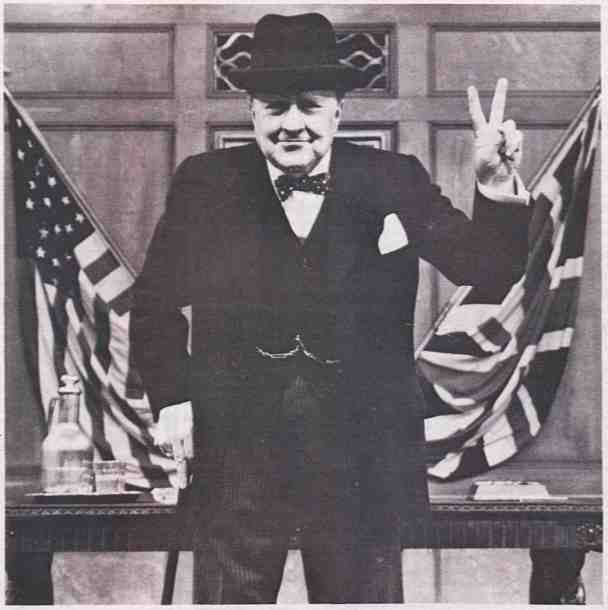
“Leaders: Churchill,” with Robert Hardy (1986)
Susskind’s WSC (update)
I have been searching for video of a stage performance of Churchill by Robert Hardy. It was produced by David Susskind in 1986 for the Public Broadcasting Network. PBS has no records older than five years. Can you help? —R.S.
The Robert Hardy performance you are looking for is “Churchill” in the David Susskind “Leaders” series. PBS broadcast the 90-minute one-man show in 1986. Robert was a the greatest Churchill ever, but his “Wilderness Years” performance, scripted by Sir Martin Gilbert, was far more accurate. The script here is laced with many errors.
Excerpts come and go on YouTube, so check there first. Here is a two-minute clip on socialism. The producers sent me a VCR at the time, and videotapes were probably once available. To find one, try searching Google or eBay for “susskind churchill” or similar word combinations.
Here is my review of Susskind in Finest Hour 52, Summer 1986:
Hardy-Winston by David Susskind
Sir John Gielgud, who ought to know better, leads off the errors: “Just after the end of World War II, Churchill was voted out of office.” (Wrong: the war was still on.) “He found himself without any immediate means.” (Wrong: the advances on his war memoirs were enormous, and in August 1946 a group of generous friends relieved him of the burden of Chartwell by buying it for the National Trust, providing that he and his wife could live out their lives there).
“And so he embarked on a lecture tour of America,” Gielgud continues. “This is what you might have seen if you were seated in the audience in Los Angeles, Chicago or Kansas City.” (No. Churchill’s final American lecture tour was in 1932. In 1946 he gave the Iron Curtain speech in Fulton, addressed the Virginia Assembly, made three other short appearances and went home.)
The first time I watched the Susskind effort I almost got up and left. By round three the edges had blurred and the rough spots had smoothed, and I began enjoying it. Admittedly I am too close to my subject. And all those involved in the production are such nice people that I hesitate to complain. As Lady Soames has often reminded us, however, there’s reason “to keep the memory green and the record accurate.”
Nits to pick
The problem with Churchill by Susskind is twofold: (1) It plants an inaccurate image in the mind of the average viewer. (2) It is laced with errors, the correction of which would have lost none of the drama and warm humanity which are its most admirable features.
Churchill never “delivered a series of informal talks across America” in 1946, as the producers state. Why say he did? Why not admit, as script writer James Humes did, that this is a composite picture, drawn from WSC’s writings?
Churchill made it a rule, when abroad, never to criticise his political opponents at home. Why then cast him in an ill-suited role as stand-up comic, stumping America to deliver one-liners about “sheep in sheep’s clothing” (a fictitious crack about Attlee)?
Robert Hardy deserves full marks for holding his audience, which responds with hearty laughter. (Both he and Humes had wanted only 60 minutes, but Susskind insisted on 90.) Hardy has Churchill’s mannerisms down perfectly and of all Churchill portrayals, his is the most convincing. But the first reaction of anyone moderately steeped in facts is that this is a vulgar caricature. Is the truth so boring that it cannot prevail?
Cornucopia of errors
Churchill would not have joked about his being seen as a wastrel by his father. Britain did not “rule all India.” And never did. He would not have said that the Lloyd George Coalition lost the 1922 election because of his work over the Middle East and Ireland. (“In spite of” would be more accurate.) Churchill never called Jock Colville “Jack,” or made the unattributed remark about Montgomery (“in victory insufferable”). He didn’t resign as Chancellor of the Exchequer because of the “Tory appeasers.” Churchill resigned as Chancellor before not after the Depression, because the Conservatives lost the 1929 election—long before appeasement became an issue.
I will not bore you with a list of inaccuracies, but here are some of the more crucial: At Malakand, WSC says, “the whole company was ambushed—except me.” (No.) In the Sudan, he says he wrote for the Morning Telegraph (a weird merger of Morning Post and Daily Telegraph). The Sudan dervishes were not nicknamed “whirling” because of the way they twirled their sabres. In Parliament he says, “I made my oath to Queen Victoria and took my seat in October 1900.” (He made his oath to King Edward VII and took his seat on 14 February 1901.)
He says he heard the news broadcast about Pearl Harbor in Downing Street. (It was at Chequers.) His famous aside, “Whatever happens at Dunkirk, we shall fight on,” was delivered in the Cabinet Room at Downing Street, not in the House of Commons. After Pearl Harbor he says he sailed for New York. (He sailed for Hampton Roads.) Such things are easily looked up.
Other people’s words
Not all of Churchill’s script is accurate. “Always give the train a sporting chance to get away” was by Clementine Churchill. “That dear and excellent woman” (Mrs. Everest) was from Gibbon, whom WSC quoted. “When all save Englishmen despaired of England’s life” was by President Kennedy. His crack about the only traditions of the Royal Navy (“rum, sodomy and flogging”) apparently occurred, but he was repeating a navy catchphrase dating back two centuries.
Churchill’s own quotes are sometimes misplaced. “Shot at without result” was said about Cuba, not Malakand. “Boneless wonder” (singular) was a blast at Ramsay MacDonald, not the Tory appeasers. Other quotes are familiar but hopelessly muddled. “They asked what my program would be—I told them Victory”… “Give us your faith and your trust” (for “trust” read “blessing”).
Other quotes are far wide of the mark. “A bull who carries his own china shop with him,” if said at all, was said about Dulles, not the State Department. When King George VI summoned Churchill on 10 May 1940 he said, “I want to ask you to form a Government,” not “take over the Government.” There is a difference.
But with all its flaws and inaccuracies, the performance brings out Churchill’s greatest characteristic. That was his essential humanity, which made him so different from other leaders past and present. James Humes noted another quality. “Churchill told his audiences what he wanted them to hear.”
And Sir John Gielgud, making up for his introduction, closes with words to remember. “Churchill was as ordinary as any of us—and as extraordinary as any of us can hope to be.”
Further reading
“The Wilderness Years with Robert Hardy,” 2019
“Tim: In Memory of Robert Hardy,” 2017
“James Humes: Irrepressible Admirer of Old Excellence,” 2020
One thought on ““Leaders: Churchill,” with Robert Hardy (1986)”
Richard, thanks for keeping the record straight. I watched this many years ago and would love to see it again. I can’t seem to find it. If nothing else, it is entertaining.