Errata & Addenda to “Churchill by Himself,” First American and English Editions
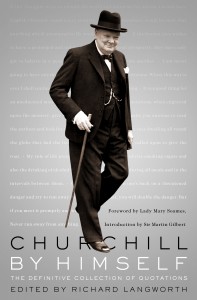
Churchill by Himself is different from all other Churchill quote books through “correctibility.” It offers a reference to each quotation, and a method by which corrections may be sent in, verified, and made available digitally to readers.
Producing any work as complicated as this is a constant running battle between conflicting sources, experts who disagree with each other, and inexorable deadlines. For instance, one expert offered corrections based on the 1974 Complete Speeches (not complete and scarcely free of errors) that contradict the texts of earlier volumes by Churchill himself—which to me take priority. Nevertheless the process of revision is endless.
Accordingly, publishers were chosen who keep books in print with frequent reprints, allowing continual revision. The Second Edition, extensively corrected down even to ellipsis points, will be published by Public Affairs in 2010. The Third Edition will be improved again, and so on.
For readers who own First Editions I offer below the most important corrections—the ones I’d dearly like to have back, and sometimes alter by hand when inscribing copies personally! A master list containing many more corrections is being prepared for the Second Edition, and I welcome being advised of any that my readers should find.
Although many persons helped compile this list, my special gratitude is owed to Professor David Dilks, former Vice-Chancellor of the University of Hull, not only for his fastidious note-taking, but for his lack of pedantry and understanding in improving the book—qualities which, I have come to learn, are rare. —RML
Note: “106/1” means page 106, column 1.
1. Corrections to British and American Editions
Page 1 caption, line 2 should read: With Sir John Anderson on Victory in Europe Day, 8 May 1945.
16/1 Difficulties, “Don’t argue the matter”: for “1941” read 1942.
23/1 Personnel. For date “1941” read 1942
25/2 Right and wrong: For date “26 May” read 27 May. In the note, lines 1-2, revise to read: WSC to Clement Davies, who ventured to suggest that President Truman meet privately with
32, third paragraph, last two lines should read: for a traitor. According to his last Private Secretary Churchill called John Foster Dulles “dull-duller-Dulles,” and it was just like him.
82/2 first note, penultimate line: for “House of Commons” read Guildhall after the war
100/1, first note, line 4, replace to read: Sidney (1622-1683, son of the Earl of Leicester)
3-8, revise to read: division of power has lain at the root of our development. We do not want to live under a system dominated either by one man or one theme. Like nature we follow in freedom the paths of variety and change and our faith is that the mercy of God will make things get better of we all try our best.
101/1 first entry, replace as follows: …elections exist for the sake of the House of Commons and not…the House of Commons…for the sake of elections. 1953, 3 November.
106/1, first editor’s note should read: Churchill was referring to Lord Rosebery (Prime Minister 1894-95), whose horses, Ladas II and Sir Visto, won the Derby in 1894 and 1895….
106/2, line 2: for “New York University” read the University of the State of New York
118/1 second quote should run before the first quote, and its dateline should read: 1940, 20 August.
130/2, second note, last sentence should read: Britain and the Commonwealth contributed $6 billion in “Reverse Lend-Lease” such as rent on airbases.
144, caption should read: WSC with Roosevelt and Stalin at Yalta, February 1945.
155/2, third date from top, for 1919 read 1929.
254/2, Ribbentrop meeting credit line should read: 1938, MARCH. (GUEDALLA, 271-72.) Revise the note to read: The Cabinet had asked Churchill to join them for lunch to bid farewell to Hitler’s Ambassador Joachim von Ribbentrop, while Austria was being absorbed by Germany. The quote is…
321/1, “Attlee,” first entry date: for “1935.” read 1940.
328/2, Brodrick note, last line: for “1860-1907” read 1890-1907
329, last line: for “Conservative” read Liberal
359/1 last note, last line: for “Duncannon” read: Dunconnel
369/2 first note should read: Conversation at a luncheon thrown by Chamberlain for the German Ambassador to Britain, Ribbentrop, 11 March 1938, at the time of the Anschluss with Austria…[etc.]
518/1, top line: for “WSC’s private secretary” read Liberal MP
527/1 second note, line 2: for “9 May” read 10 May.
544/1 second entry: For “Nazim” read Nazimuddin. For the date “1941” read 1953
556/1 “Practice,” note, line 2: for “Moseley” read Mosley.
561 footnote line 1: for “1954” read 1945.
570, paragraph 4 line 1: revise last sentence to read: For example, “The heaviest cross I have to bear is the Cross of Lorraine” is so well established that I was surprised to learn that someone else said it.
573: delete “Dull, duller, Dulles” which has been attributed.
575: delete “Grace of God” and “Impromptu remarks” which have been attributed.
 2. Corrections to the First British Edition only.
(All of the following have been made in the American edition)
11 caption line 2 should read: In a tommy’s helmet visiting the defences at Dover, 1943.
132/2 top entry: for 27 read 28 June.
380 caption, line 2: delete “in Woodford”
532 caption: For “study” read bedroom.
3. Addenda
I have found two instances where Churchill’s words were incorrect (or, more likely, his transcribers were): On page 528, column 2, line 7, Churchill said “sixteen years later” but should have said “six.” On page 553, column 2, “Interruptions, answering,” Churchill is recorded as saying “abrogated,” but almost certainly he said “arrogated.”
Page 20, column 2, first entry: Manfred Weidhorn brings to my attention a previous occurrence of almost the same words, in Churchill’s essay, “A Second Choice” (1931, March. Strand Magazine; Thoughts, 11): The journey has been enjoyable and well worth making—once.”
Page 322, Stanley Baldwin: A distinguished historian has suggested to me that Churchill’s attitude toward Baldwin was not as uniformly critical as the quotes here listed. He quoted WSC’s praise of SB at the Party Conference in October 1935 and in private letters, and noted that Churchill visited Baldwin’s home in 1950, after SB’s death. I believe however that Churchill was singularly critical of Baldwin, per Martin Gilbert’s In Search of Churchill, as quoted here, and outlined my reasons in “How Churchill Saw Others: Stanley Baldwin,” Finest Hour 101, Winter 1998-99.
Page 360, Marshall, note 2: It has been suggested to me that Churchill met Lazare Carnot (see under Trotsky, page 375), but I am not sure. Sadi Carnot was a reconciler, Lazare a revolutionary. Though the latter was known as “the organizer of victory,” I am not sure Churchill thought of Marshall in quite those terms.
Page 573 (main entry), also 32, 570: “Dull-duller-dulles” (with the hyphens) has been attributed, by Sir Anthony Montague Browne (Long Sunset), 126.’’ Thanks to Jim Lancaster for digging out this and several other attributions in Sir Anthony’s book.
Page 576, column 2: Leise Christensen has advised me that when the Duke of Northumberland said “A living dog is better than a dead lion,” he was himself quoting from Ecclesastes 9:4.
Page 579, “Best of Everything”: Thanks to Robert Pilpel for reporting that George Bernard Shaw preceded both F.E. Smith and Churchill with this line in his play, “Major B” (1905), when Lady Britomart says (act 1, scene 1): “I know your quiet, simple, refined, poetic people like Adolphus—quite content with the best of everything!”