Posts tagged as:

Zionism


The Gates of Auschwitz, with the slogan "Arbeit Macht Frei." (Wikimedia Commons)

The gates of Auschwitz, with the slogan "Arbeit Macht Frei." (Wikimedia Commons)

In the January issue of Commentary, Hillel Halkin penned an interesting piece, “The Jewish State & Its Arabs,” which resulted in a flurry of reader comment on the Commentary website.

One reader had the impression that Churchill “overreacted” to the 1944 assassination of Lord Moyne by members of the Jewish Lehi (Stern Gang). Another wrote something I just could not let pass without rejoinder:

…had Churchill given an order to bomb Auschwitz, rather than simply recommend that it be bombed, it would have been bombed. He did not do so, presumably, because he was loath to quarrel with his general staff and did not wish to stand accused of risking British pilots and air crews in order to save Jewish lives that had no military value.

To the Editor of Commentary:

Churchill was no more “overreacting” to the assassination of Lord Moyne by the Stern Gang than he was able to assure the bombing of Auschwitz. Churchill deplored terrorism regardless of its source; and, while he quarreled with his general staff frequently, he did not have plenary authority over the U.S. Army Air Force—the responsible agency for bombing in the Auschwitz sector.

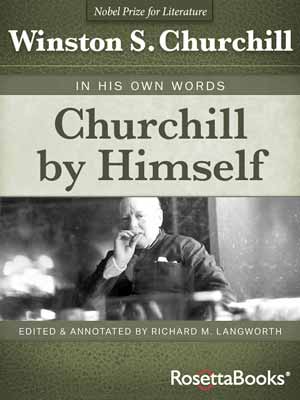
1) From Churchill by Himself, World Politics chapter, page 442, Winston S. Churchill in the House of Commons, 17 November 1944 (source: Sir Martin Gilbert, Winston S. Churchill, VII: 1052):

If our dreams for Zionism are to end in the smoke of assassins’ pistols, and our labours for its future to produce only a new set of gangsters worthy of Nazi Germany, many like myself will have to reconsider the position we have maintained so consistently and so long in the past. If there is to be any hope of a peaceful and successful future for Zionism, these wicked activities must cease, and those responsible for them must be destroyed root and branch.

Editor’s note: “Churchill was a friend of Jews, but not an uncritical friend. Outraged when his friend Lord Moyne (Walter Guinness), the Minister Resident in Cairo, was shot with his driver by members of the terrorist Stern Gang on 5 November 1944, Churchill suggested the Colonial Secretary, Oliver Stanley, should impress upon Zionist leader Chaim Weizmann “that it was incumbent on the Jewish Agency to do all in their power to suppress these terrorist activities.”

2) From Martin Gilbert, “Churchill and the Holocaust,” United States Holocaust Museum, Washington, 1993 International Churchill Conference:

Five prisoners escaped from Auschwitz in order to bring news to the West of what was happening to the Jews there. Four were Jews. One was a Polish Catholic medical student. The moment their information reached the West, the moment the “unknown destination” was revealed as Auschwitz, and the truth of the gas chambers there made clear, there was a tremendous and understandable outcry. (The first thing that has always struck me is: what would have happened if these escapees had made their way West in 1943 or even at the end of 1942?) The impact of their report on the Jewish and non-Jewish world was dramatic, and traumatic….

On 6 July 1944, in a meeting with Anthony Eden, Weizmann and Shertok made five urgent and desperate suggestions [the fifth of which was] “that the railway line leading from Budapest to Birkenau, and the death camp at Birkenau and other places, should be bombed.”

When Churchill was shown this request by Eden, he did something I’ve not seen on any other document submitted to Churchill for his approval: He wrote on it what he wanted done.

Normally, he would have said, “Bring this up to War Cabinet on Wednesday,” or, “Let us discuss this with the Air Ministry.” Instead, he wrote to Eden on the morning of 7 July: “Is there any reason to raise this matter with the Cabinet? Get anything out of the Air Force you can, and invoke me if necessary.”

I have never seen a minute of Churchill’s giving that sort of immediate authority to carry out a request….I suppose it is a great tragedy that all this had not taken place on 7 July 1943 or on 7 October 1942. For when all is said and done, by 7 July 1944 it was too late to save all but a final 100,000.

There is a vast subtext, of which I have written in my book, Auschwitz and the Allies. The British officials did not know on 9 July that the deportations had ceased, so they had to deal with the Prime Minister’s request on the assumption that it still had some validity, and in the course of dealing with it, some of them revealed considerable distaste for carrying out any such instruction.

It is interesting, however, to note that when the request was put to the American Air Force Commander, General Ira C. Eaker, when he visited the Air Ministry a few days later, he gave it his full support. He regarded it as something that the American daylight bombers could and should do. But as you also know, from the letter which is put up in the Museum, when the request reached Washington—indeed, on the five separate occasions when the request reached Washington—it was turned down. On the second occasion that it reached the Assistant Secretary of War, John J. McCloy, he told his assistant to kill it; and it was then effectively killed. The debate about bombing those particular lines continued for more than a month after the lines were no longer in use.

I spoke to a number of those who would have been involved in bombing the lines, as Churchill had wished, and even bombing the camp installations, had the deportations not stopped. One thing which greatly heartened me, from my perspective, from my window as a Jew, was that all the pilots and air crew I spoke to, who would have had to do the work, were emphatic that they would have done it, and were ashamed and angry that they had not been asked to do it.

Aerial photograph of Auschwitz, December 1944.

Aerial photograph of Auschwitz, December 1944.

I even found the young man who had taken that aerial photograph of the camp which is displayed in the Museum, a South African photo reconnaissance pilot. He was in extreme distress at the thought that, on the four separate occasions when he flew over the camp with his camera, he had no idea what it was he was flying over. He flew only an unarmed plane, but as he said to me very touchingly, “Had I known, I could at least have tipped my wing to show the people there that someone knew they were there.”

Churchill had no doubt that a terrible crime had been committed. As he wrote to Anthony Eden on the day that the escapees’ account of the truth about Auschwitz and the “unknown destination” reached him:

“There is no doubt that this is probably the greatest and most horrible crime ever committed in the whole history of the world, and it has been done by scientific machinery by nominally civilised men in the name of a great State and one of the leading races of Europe. It is quite clear that all concerned in this crime who may fall into our hands, including the people who only obeyed orders by carrying out the butcheries, should be put to death after their association with the murders has been proved. Declarations should be made in public, so that everyone connected with it will be hunted down and put to death.”


{ 0 comments }

A recent article declares: “Churchill, a Zionist, was the first politician to call for the creation of  Israel in 1905.” Where exactly did he say that? —G.H., New York City

Churchill was certainly pro-Zionist by 1905, but I can find no public statement calling for an independent Israel before her actual independence in 1948. Until then he called for a “Jewish National Home,” believing, with what cynics might call incurable optimism, that Arabs and Jews in Palestine could coexist peacefully, pointing to the benefits the Jews had brought in the form of irrigation and horticulture. 

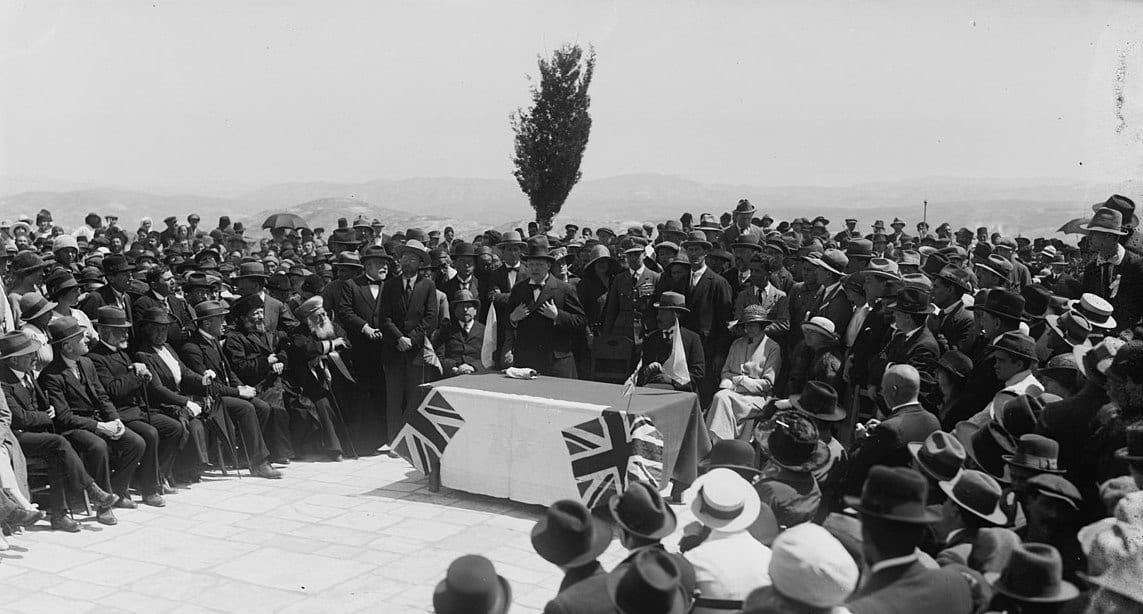
In 1921, when setting up the borders of the modern Middle East, Churchill opted not for an independent Israel but what he called a “Jewish National Home” within Britain’s Palestine Mandate, generally coinciding with what is now Israel. The rest of the Palestine Mandate became the Arab state of Jordan. To a delegation of Palestinian Arabs in Jerusalem on 28 March 1921 Churchill declared:

Palestine (Wikipedia Commons)

Palestine (Wikipedia Commons)

…it is manifestly right that the Jews, who are scattered all over the world, should have a national centre and a National Home where some of them may be reunited. And where else could that be but in this land of Palestine, with which for more than 3,000 years they have been intimately and profoundly associated? (Churchill by Himself, 175)

Zionist leader Chaim Weizmann (wearing Arab headdress as a sign of friendship) with then-Emir Feisal in Syria. (Wikipedia Commons)

Churchill’s impressive achievement at that time was to convince two Arab potentates, King Abdullah in Jordan and King Feisal in Iraq, to tolerate a Jewish Homeland in their midst. This situation prevailed until Britain gave up the Palestine Mandate after World War II, which led to the 1948 war in which Israel secured independence.

Speaking in the House of Commons on 10 December 1948, Churchill regretted that Britain and the West had lost the opportunity to make a permanent settlement. This was his first admission that I could find that he considered partition and an independent Israel before the event—albeit in hindsight:

I always had in my mind the hope that the whole question of the Middle East might have been settled on the largest scale on the morrow of victory and that an Arab Confederation, comprising three or four Arab States—Saudi-Arabia, Iraq, Transjordania, Syria and the Lebanon—however grouped, possibly united amongst themselves, and one Jewish State, might have been set up, which would have given peace and unity throughout the whole vast scene of the Middle East. As to whether so large a policy could have been carried into being I cannot be sure, but a settlement of the Palestine question on the basis of partition would certainly have been attempted, in the closest possible association with the United States and in personal contact with the President, by any Government of which I had been the head. But all this opportunity was lost. (Churchill by Himself, 176-77)

Churchill supported Israel, declaring in the House of Commons on 26 January 1949: “…the coming into being of a Jewish State in Palestine is an event in world history to be viewed in the perspective, not of a generation or a century, but in the perspective of a thousand, two thousand or even three thousand years.” (Churchill by Himself, 175)

But on 30 July 1951 he again deplored post-World War II British policies, which, he said, had “led to the winding up of our affairs in Palestine in such a way as to earn almost in equal degree the hatred of the Arabs and the Jews.”  (Churchill by Himself, 439).
Almost everyone who still has hope for Churchill’s optimism accepts a “two state solution” for Palestine/Israel, but the existence of two separate Palestinian entities, Gaza and the West Bank, subdivides the Arab population. Any solution with a decent chance of success must contemplate a shift of peoples, in which one population or another is physically moved to create a contiguous Arab state. And nobody seems to want to grasp that nettle. Even in 1948, Churchill recognized that it would not be easy.

{ 0 comments }