Posts tagged as:

Munich

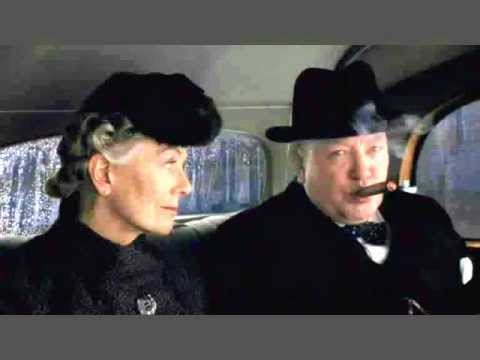
“The Gathering Storm,” a film for television produced by BBC Films and HBO Inc., starring Albert Finney as Winston Churchill and Vanessa Redgrave as Clementine, first aired April 2002, 90 minutes.

Churchill films seldom engender unanimity, but everyone who watched the preview, by kind invitation of the British Consul in Boston, had the same reaction to “The Gathering Storm”: astonishment at just how good it was. Even in a cynical and anti-hero age, filmmakers still can recreate what Lady Soames calls “The Saga” without reducing Churchill to a flawed burlesque or a godlike caricature. With the exception of one huge gap in the story line, “The Gathering Storm” is a masterpiece.

Unexpectedly in the male-dominated world of the 1930s, but perhaps intentionally in 2002, the two greatest supporting roles are female. Clementine Churchill is one of these. Badly misplayed by Sian Phillips in the “Wilderness Years” documentary two decades ago (Finest Hour 38), Clemmie gets justice here at the hands of Vanessa Redgrave.

Redgrave not only looks the part–Winston Churchill, who should know, tells me the resemblance is uncanny. But scriptwriter Hugh Whitemore has also provided her with exactly the right lines as she cajoles, scolds, wheedles and encourages her husband. “I often put myself in Clemmie’s shoes,” wrote Lady Diana Cooper, “and as often felt how they pinched and rubbed till I kicked them off, heroic soles and all, and begged my husband to rest and be careful. Fortunately, Clemmie was a mortal of another clay.” (Finest Hour 83:13).

Equally compelling is Ava (Lena Headey), the beautiful wife of Ralph Wigram (Linus Roache) a Foreign Office official who, as Martin Gilbert revealed in the official biography, risked his career to bring Churchill secret documents on Germany’s rearmament. Devotedly, Ava bears her husband’s strain, their deep concern for their young, autistic son, and the worst that politics can throw at her.

Angered by Wigram’s aid to Churchill, a government toady named Pettifer (in fact it was Board of Trade President Walter Runciman) visits Ava with a threat: If her husband doesn’t stop helping Churchill he will be transferred abroad, leaving Ava and the boy alone in London. She promptly tells him to do his worst and throws him out.

This is an overdue tribute to a little-known heroine. Ava Bodley married Ralph Wigram in 1925. After Ralph’s death from polio in 1936 she wrote to WSC: “He adored you so & always said you were the greatest Englishman alive.” In 1941 she married John Anderson, later Viscount Waverly, Home Secretary and Chancellor of the Exchequer in Churchill’s wartime government, for whom the Anderson Shelter was named. Churchill was devoted to Ava all his life. When Anderson died in 1958, Gilbert reports, Churchill telephoned her from Chartwell: “After commiserating with her on Lord Waverly’s death he was silent for a while, then said to her with what sounded like tears in his voice, ‘For Ralph Wigram grieve.’”

Albert Finney, who plays Winston Churchill, is ten or fifteen years too old and looks more like WSC’s nephew Peregrine. But his mannerisms and pale blue eyes are right, and he grows on you, despite unnecessary toilet scenes and red velvet siren suits worn round the clock. Finney overplays the role—every Churchill impersonator does, except the inimitable Robert Hardy. But he is all right. Again Whitemore’s script comes through: here and there is a snatch of words Churchill spoke in later or different contexts (e.g., a 1939 broadcast to America recast as a Commons speech in 1936). But the flow is so seamless that only the determined critic will notice.

The rest of the casting is good—not perhaps as physically exact as in “The Wilderness Years,” but convincing and finely directed by Richard Loncraine. Sarah Churchill should have had a flame red wig to hide that mousy hair, and Brendan Bracken also starts too dark-haired, though his mop reddens as the crisis mounts! Randolph Churchill is too young and silly; Nigel Havers was a better Randolph in the 1982 version. Derek Jacobi makes a lifelike Stanley Baldwin. Sir Robert Vansittart (Tom Wilkinson) is the uneasy Undersecretary of State for Foreign Affairs, balancing loyalty to his government with fear for his country, saying of Churchill, “he demands total loyalty,” and implying that it’s worth it.

The opening scenes at Chartwell in 1934 play like William Manchester’s prologue to his second volume of The Last Lion, providing a penetrating look at the household down to “Mr. Accountant Woods,” who on cue pronounces Winston’s finances a shambles. Winston’s hobbies—painting, bricklaying, feeding his fish, watching his pigs (the famous pig line is de rigueur)—are nicely done, though the fishpond is not the one at Chartwell. Mary Churchill (now Lady Soames) looks more like a young Chelsea Clinton than the beautiful Mary, but Ronnie Barker is ideal as Inches, the long-suffering and devoted butler.

If this film were not so good, the gap in the story line would be unforgivable: After 1936 and Baldwin’s retirement as Prime Minister, we skip ahead to the war and Churchill’s arrival at the Admiralty. How can a film entitled “The Gathering Storm” ignore the premiership of Neville Chamberlain and Munich?

Granted, there are only ninety minutes, and one can understand the omission of, say, the Abdication Crisis. But without Munich the story falls short of its dramatic potential. Sadly too, Churchill in Commons mainly utters only banal statistics about aircraft production (too often to an empty House—most times he packed the place). By devoting fewer minutes to India and aircraft, they could have allowed Finney to tackle that most famous prewar oration, after Munich: “I have watched this famous island descending the stairway which leads to a dark gulf.”

A minor flaw is the failure to identify all the characters. Modern audiences would benefit from seeing the credits before the film, the actors portrayed alongside a few lines identifying the characters they represent. But there’s little else to criticize, and what’s missing in 1937-39 is balanced by what’s included in 1934-36. Perhaps they’ve left room for a sequel?

The essence of this film is not so much the urgency of the hour, the naivete of Britain’s leaders, their refusal to act “until self-preservation strikes its jarring gong,” Churchill’s defiant warnings when nobody would listen (his true finest hour, many think)—and the relevance of Britain’s inertia to our growing lethargy today, in the face of equally perilous threats. All that is there—but primarily this is a love story.

The intensity of Winston and Clementine’s devotion to one another permeates the tale. From their spats over money to their rapid reconciliations; from Winston’s chagrin at Clemmie’s four-month sojourn in the South Seas (“If it weren’t for Mary I’d be awfully miserable”), to his impromptu romp through his fishpond upon her return; to his touching tribute as he heads for the Admiralty (“thank you for loving me”), the film exudes the emotional ties that all marriages should have, and theirs did. Churchill once described his marriage: “Here firm, though all be drifting.” Fortunately for him, it really was. Give BBC and HBO a tip of the hat.


{ 2 comments }

First published in Finest Hour 38, Winter-Spring 1982-83

Well, it was a great show, folks. And, inasmuch as any TV epic about Churchill is a plus, we welcomed and enjoyed it. We are beholden to WGBH in Boston, which most kindly mentioned Finest Hour in the letter sent to anyone who inquired about Martin Gilbert’s accompanying Wilderness Years book, resulting in fifty new members to date. Withal, we don’t have much to complain about.

So why critique it? Mainly because it is so universally praised. I thought it good, but not that good; well casted, but not that well casted; accurate, but not  that accurate.

We may dismiss Lord Boothby’s complaint (Finest Hour 36:3) that the Winston of this series is “a grumpy, vindictive old man [who] shouts all the way through.” Robert Hardy captures what Martin Gilbert’s books tell us was the Churchill of the Thirties: politically frustrated, less than effective as a father, worried over many ominous developments—and simultaneously enjoying one of his most productive decades as a writer and historian, not to mention his zenith as a bricklayer and continued progress as an artist. Perhaps it would be remarkable of anyone else, but while engaged in a half-dozen literary projects, any one of which would occupy a normal man fully, Churchill turned Chartwell into a paradise and continued to be a force, however spurned, in politics. His only wilderness was the one political observers assigned to him.

And this, after all, is the weakness of the production. It is admittedly hard to provide much TV action around the writing of Marlborough, though we’d have enjoyed seeing one of the old Duke’s battlefields, with Churchill reciting a few lines of description from his great biography. And there’s no drama to building a brick wall.

We are given instead the stuff that plays well: politics, love, scandal, hate. Here enter several exaggerations. Adolf Hitler (Gunter Meisner), on the eve of power, glares through a restaurant window at the Churchill he refuses to meet—of course, the real Hitler did no such thing. Neville Chamberlain (Eric Porter), and his toady Sir Horace Wilson (Clive Swift –the “Richard Bucket” of “Keeping Up Appearances”) go on thinking well of Hitler even after March 1939—which is unfair to Chamberlain, who saw by then what he was up against. The knowledgeable Professor Russ Jones of Westminster College assures us that the desert scene with William Randolph Hearst (Stephen Elliott) and Marion Davies (Merrie Lynn Ross),  never happened.

On the other hand, “The Wilderness Years” brings out some facets of the period extremely well. Randolph (Nigel Havers) couldn’t be more like Randolph. The risks run by Ralph Wigram (Paul Freeman), Desmond Morton (Moray Watson) and Wing Commander Tor Anderson (David Quilter), in bringing Churchill news of German rearmament, are rightly emphasized. If we hadn’t realized how often Stanley Baldwin (Peter Barkworth) played Churchill foul in the 1930s (and how often WSC forgave him), “Wilderness Years” does tell us bluntly.

In general the casting was superb, as only British television can make it, with an army of brilliant actors among whom can always be found a near-clone of anybody. I thought Baldwin was too pixieish, Ramsay MacDonald (Robert James) too mousy, Hitler a caricature. But Frederick Lindemann, “The Prof” (David Swift), Brendan Bracken (Tim Pigott-Smith), Lord Beaverbrook (Stratford Johns), Lord Derby (Frank Middlemass, transformed from the kindly Headmaster in “To Serve Them All My Days”) and Neville Chamberlain couldn’t have been closer to life. Samuel Hoare (Edward Woodward) comes across as the evil force he really was.

Most of the women—WSC’s vivacious sister-in-law “Goonie” (Jennifer Hilary), noisy Nancy Astor (Marcella Markham), Sarah Churchill (Chloe Salaman)— were well played, with one terrible exception. Clementine Churchill (Sian Phillips) was simply awful. A friend who remembers Phillips for her role in the Roman drama “I Claudius” says: “I keep seeing her sipping wine and wearing a toga.”

This is not the “Clemmie” we have known through Martin Gilbert’s and Mary Soames’ biographies, but a spoiled, pretentious, unhappy ex-deb, not Winston’s pillar of strength but a flitting mayfly, ever ready to run off with some handsome adventurer. All the more curious (for Phillips said she researched the role), Clemmie is at sea both literally and figuratively. The scene in which she returns from her South Seas voyage with an unnamed swashbuckler (in life, Terence Phillip) would thrill the National Enquirer, however insubstantial its implications. Phillips could have saved the part by reciting a few of the real Clementine’s letters during that voyage: “Do not be vexed with your vagabond cat. She has gone off toward the jungle with her tail in the air, but she will return presently to her basket and curl down comfortably.”

Speaking of recitations, we could have done without the bowdlerization of Churchill’s great speeches. Robert Hardy has his part down perfectly, and one soon forgets the lovable vet Siegfried Farnon in “All Creatures Great and Small.” But almost every great speech, though beautifully delivered, was mercilessly cut to ribbons by the editors. The hatchet job on Churchill’s greatest prewar speech (“I have watched this famous Island…”) is unforgivable.

In all, though, it was a great yarn. What historical character other than Churchill can you think of who could so excite a TV audience during his life’s lowest ebb? As ever, he stands alone. I hope that the fine reception of “The Wilderness Years” has been sufficient to encourage further dramatizations of equally important periods—particularly the Admiralty sojourn of 1911-15, and of course, 1940. We’ll be waiting for it.


{ 0 comments }

War and Shame

February 2, 2009

What did Churchill say about those who trade honor for peace having in neither in the end? —D.B. There are two likely quotations. The first was Churchill in a letter to Lloyd George on 13 August 1938, just before the Munich Conference: I think we shall have to choose in the next few weeks between [...]

Read the full article →