Posts tagged as:

Gathering Storm

Great website! I am a psychologist writing a book manuscript on the biological basis of self-confidence. Long an admirer of Churchill, I would like to use a quote from the film The Gathering Storm to demonstrate Churchill’s tremendous confidence. Can you help me find Churchill’s statement (in the film) to Ralph Wigram, that when he was a boy, a feeling had come to him that one day Britain would be in great danger, and it will fall to him to save London? —B.J.S.

Thanks for the kind words. Privately the Churchill of early World War II was not so confident as in his speeches proclaimed. In May 1940 he said to his bodyguard, Walter Thompson, “I hope I’m not too late.” Later he confided to Roosevelt that the Germans might well invade Britain and install a puppet government. While assuring FDR that such a government would not be run by him, he suggested they might install the British fascist leader Oswald Mosley “or some such person.”

As France was falling in May 1940, Churchill did not favor seeking an armistice with Germany. But Neville Chamberlain’s diary for the end of May records Churchill as saying that “if we could get out of this jam by giving  up Malta and Gibraltar and some African colonies, he would jump at the chance.” Of course, he may have just been throwing a bone to Lord Halifax, who was arguing for an approach to Hitler through Mussolini’s “good offices.” (The mind boggles.)

Nevertheless, the brilliant dialogue in The Gathering Storm about foreseeing the future has its origins in fact. It came when Churchill was 17 years old, as quoted in  Sir Martin Gilbert’s In Search of Churchill, page 215:

…I can see vast changes coming over a now peaceful world; great upheavals, terrible struggles; wars such as one cannot imagine; and I tell you London will be in danger—London will be attacked and I shall be very prominent in the defence of London. I see further ahead than you do. I see into the future. This country will be subjected somehow, to a tremendous invasion, by what means I do not know, but I tell you I shall be in command of the defences of London and I shall save London and England from disaster.…dreams of the future are blurred but the main objective is clear. I repeat—London will be in danger and in the high position I shall occupy, it will fall to me to save the Capital and save the Empire.

Sir Martin explains that he was given this quote by Churchill’s Harrow schoolmate Muirland Evans, who recalled their conversation “in one of those dreadful basement rooms in the Headmaster’s House, a Sunday evening, to be exact, after chapel evensong.…We frankly discussed our futures. After placing me in the Diplomatic Service…or alternatively in finance, following my father’s career, we came to his own future….”

See also my review of The Gathering Storm on this website.


{ 0 comments }

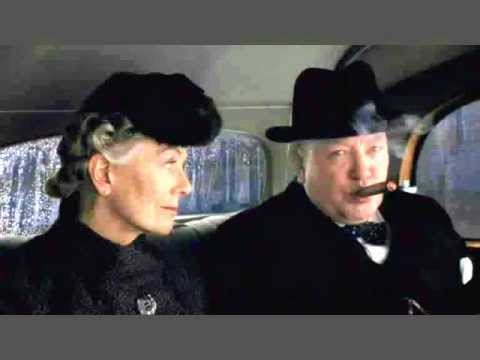
“The Gathering Storm,” a film for television produced by BBC Films and HBO Inc., starring Albert Finney as Winston Churchill and Vanessa Redgrave as Clementine, first aired April 2002, 90 minutes.

Churchill films seldom engender unanimity, but everyone who watched the preview, by kind invitation of the British Consul in Boston, had the same reaction to “The Gathering Storm”: astonishment at just how good it was. Even in a cynical and anti-hero age, filmmakers still can recreate what Lady Soames calls “The Saga” without reducing Churchill to a flawed burlesque or a godlike caricature. With the exception of one huge gap in the story line, “The Gathering Storm” is a masterpiece.

Unexpectedly in the male-dominated world of the 1930s, but perhaps intentionally in 2002, the two greatest supporting roles are female. Clementine Churchill is one of these. Badly misplayed by Sian Phillips in the “Wilderness Years” documentary two decades ago (Finest Hour 38), Clemmie gets justice here at the hands of Vanessa Redgrave.

Redgrave not only looks the part–Winston Churchill, who should know, tells me the resemblance is uncanny. But scriptwriter Hugh Whitemore has also provided her with exactly the right lines as she cajoles, scolds, wheedles and encourages her husband. “I often put myself in Clemmie’s shoes,” wrote Lady Diana Cooper, “and as often felt how they pinched and rubbed till I kicked them off, heroic soles and all, and begged my husband to rest and be careful. Fortunately, Clemmie was a mortal of another clay.” (Finest Hour 83:13).

Equally compelling is Ava (Lena Headey), the beautiful wife of Ralph Wigram (Linus Roache) a Foreign Office official who, as Martin Gilbert revealed in the official biography, risked his career to bring Churchill secret documents on Germany’s rearmament. Devotedly, Ava bears her husband’s strain, their deep concern for their young, autistic son, and the worst that politics can throw at her.

Angered by Wigram’s aid to Churchill, a government toady named Pettifer (in fact it was Board of Trade President Walter Runciman) visits Ava with a threat: If her husband doesn’t stop helping Churchill he will be transferred abroad, leaving Ava and the boy alone in London. She promptly tells him to do his worst and throws him out.

This is an overdue tribute to a little-known heroine. Ava Bodley married Ralph Wigram in 1925. After Ralph’s death from polio in 1936 she wrote to WSC: “He adored you so & always said you were the greatest Englishman alive.” In 1941 she married John Anderson, later Viscount Waverly, Home Secretary and Chancellor of the Exchequer in Churchill’s wartime government, for whom the Anderson Shelter was named. Churchill was devoted to Ava all his life. When Anderson died in 1958, Gilbert reports, Churchill telephoned her from Chartwell: “After commiserating with her on Lord Waverly’s death he was silent for a while, then said to her with what sounded like tears in his voice, ‘For Ralph Wigram grieve.’”

Albert Finney, who plays Winston Churchill, is ten or fifteen years too old and looks more like WSC’s nephew Peregrine. But his mannerisms and pale blue eyes are right, and he grows on you, despite unnecessary toilet scenes and red velvet siren suits worn round the clock. Finney overplays the role—every Churchill impersonator does, except the inimitable Robert Hardy. But he is all right. Again Whitemore’s script comes through: here and there is a snatch of words Churchill spoke in later or different contexts (e.g., a 1939 broadcast to America recast as a Commons speech in 1936). But the flow is so seamless that only the determined critic will notice.

The rest of the casting is good—not perhaps as physically exact as in “The Wilderness Years,” but convincing and finely directed by Richard Loncraine. Sarah Churchill should have had a flame red wig to hide that mousy hair, and Brendan Bracken also starts too dark-haired, though his mop reddens as the crisis mounts! Randolph Churchill is too young and silly; Nigel Havers was a better Randolph in the 1982 version. Derek Jacobi makes a lifelike Stanley Baldwin. Sir Robert Vansittart (Tom Wilkinson) is the uneasy Undersecretary of State for Foreign Affairs, balancing loyalty to his government with fear for his country, saying of Churchill, “he demands total loyalty,” and implying that it’s worth it.

The opening scenes at Chartwell in 1934 play like William Manchester’s prologue to his second volume of The Last Lion, providing a penetrating look at the household down to “Mr. Accountant Woods,” who on cue pronounces Winston’s finances a shambles. Winston’s hobbies—painting, bricklaying, feeding his fish, watching his pigs (the famous pig line is de rigueur)—are nicely done, though the fishpond is not the one at Chartwell. Mary Churchill (now Lady Soames) looks more like a young Chelsea Clinton than the beautiful Mary, but Ronnie Barker is ideal as Inches, the long-suffering and devoted butler.

If this film were not so good, the gap in the story line would be unforgivable: After 1936 and Baldwin’s retirement as Prime Minister, we skip ahead to the war and Churchill’s arrival at the Admiralty. How can a film entitled “The Gathering Storm” ignore the premiership of Neville Chamberlain and Munich?

Granted, there are only ninety minutes, and one can understand the omission of, say, the Abdication Crisis. But without Munich the story falls short of its dramatic potential. Sadly too, Churchill in Commons mainly utters only banal statistics about aircraft production (too often to an empty House—most times he packed the place). By devoting fewer minutes to India and aircraft, they could have allowed Finney to tackle that most famous prewar oration, after Munich: “I have watched this famous island descending the stairway which leads to a dark gulf.”

A minor flaw is the failure to identify all the characters. Modern audiences would benefit from seeing the credits before the film, the actors portrayed alongside a few lines identifying the characters they represent. But there’s little else to criticize, and what’s missing in 1937-39 is balanced by what’s included in 1934-36. Perhaps they’ve left room for a sequel?

The essence of this film is not so much the urgency of the hour, the naivete of Britain’s leaders, their refusal to act “until self-preservation strikes its jarring gong,” Churchill’s defiant warnings when nobody would listen (his true finest hour, many think)—and the relevance of Britain’s inertia to our growing lethargy today, in the face of equally perilous threats. All that is there—but primarily this is a love story.

The intensity of Winston and Clementine’s devotion to one another permeates the tale. From their spats over money to their rapid reconciliations; from Winston’s chagrin at Clemmie’s four-month sojourn in the South Seas (“If it weren’t for Mary I’d be awfully miserable”), to his impromptu romp through his fishpond upon her return; to his touching tribute as he heads for the Admiralty (“thank you for loving me”), the film exudes the emotional ties that all marriages should have, and theirs did. Churchill once described his marriage: “Here firm, though all be drifting.” Fortunately for him, it really was. Give BBC and HBO a tip of the hat.

{ 2 comments }