Posts tagged as:

Churchill Centre

You can read about Winston Churchill’s career elsewhere. I’d like rather to indulge in the remembrance of a friend.

We met through the post forty-two years ago, when he became the third honorary member of the Churchill Study Unit, after his grandmother and his father. The latter had only just sent a letter of encouragement to our little group of stamp collectors when he himself died. It was June, 1968. In sending condolences, I asked Winston to take his father’s place. He accepted, adding, “It is consoling to know so many share my loss.”

And for four decades “Young Winston” was a stalwart supporter, friend and a collaborator on projects too numerous to recount. While kidding him that he was fast getting to be the “Not-So-Young Winston,” I felt he was timeless, always there for us: encouraging, prodding, donating, participating. My grief at his loss, far too soon, is deeply felt.

He gave us permission to publish his grandfather’s articles and speeches in Finest Hour. He appeared for speeches and presentations, from conferences to our Churchill Tours of England. He officiated at joint ceremonies like the commissioning of USS Winston S. Churchill, the American Veterans Center, our 2006 Churchill Lecture. When we founded The Churchill Centre in 1995, he was among the first to contribute to its endowment. He freely allowed his signature to be used on solicitations, most recently in a letter asking lapsed members to renew, which, eerily, was received by some after his death.

Like his father, he preferred to communicate by telephone, announcing himself with a cheery “Winston here!” He would call to tell of his adventures, from flying desperate medical missions for St. John Ambulance Air Wing to exploring scenes of his grandfather’s exploits—like the Malakand Pass, where he rode in an armoured car accompanied by soldiers armed to the teeth. Truly, he lived life large. In London and Washington, he knew everybody, just like his mother. As they said of Alistair Cooke: “He could reach back, reach forward, and make the connections. He was always, triumphantly, in touch.”

On one of his trips to New England, when promoting his book of Sir Winston’s writings about America, The Great Republic, we took him to visit Plimoth Plantation. There he accosted an Indian, assuring him they were related, “since my grandfather was part-Iroquois.” Back in the car I let him have it: “Winston, you’re as Iroquois as my cat!” “If you’re so smart,” he said, “prove it. Meanwhile it’s my story and I’m running with it!”

When I first visited him in London, he showed me his personal memorabilia. Here was the peerless Orpen portrait of his sad grandfather after the Dardanelles; an ornamental table once owned by John Churchill First Duke of Marlborough; a collection of WSC’s works, all first editions inscribed by his grandfather. I was a Churchill bookseller at the time, and he wanted to know what I thought of his collection. “Well,” I said, “you’ve made a good start…..”

We had several literary collaborations. When he assembled Never Give In!, his collection of Sir Winston’s best speeches, I was able to dig out some obscure ones he needed, like his grandfather’s remarks in Durban after escaping from the Boers in 1899. His writings appeared in Finest Hour, most recently in recounting the heroic contributions of Poles in World War II, in issue 145. Sir Martin Gilbert read it without realizing who wrote it: “I said to myself, wow,this is really good, I wonder who wrote it (wish it had been me!)”

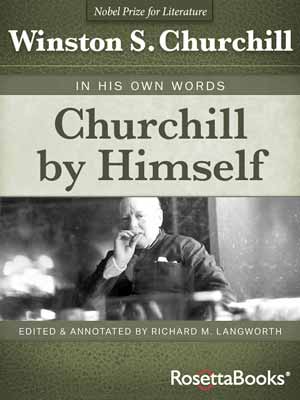
Our largest “combined operation” was Churchill By Himself, the book I couldn’t have produced without his permission. Winston provided his grandfather’s words, I provided editorial notes. This, I assured him, would be “a production to rival South Pacific: music by W. Churchill, lyrics by R. Langworth.”

There were amusing adventures, like his call for “cigar quotes” for a company producing a new Churchill corona. I supplied the quotes and he asked if I wanted to be paid. “Yes,” I said, “with a box of cigars.” Sniffed Winston: “I don’t touch the dreadful things myself, but there’s no reason you shouldn’t kill yourself if you wish.” The box duly arrived with the price still on it, and I was temporarily elevated to smoking a twenty-five dollar corona, courtesy of my friend in London. (Recently I gave one to a Bahamian pal, its elaborate band sparkling with a red and gilt Churchill coat of arms. He looked as if he’d received a knighthood.)

Political labels are all too freely applied, and some labeled Winston a right-winger, but his views were too complex to be pigeonholed. True, he broke with Mrs. Thatcher by voting against sanctions on Rhodesia; he deplored the skinning-down of Britain’s armed forces; he worried publicly over unrestricted Commonwealth immigration and the muslimization of his country. But he was also pro-Europe; he strove for a more classless society. And last year, when Barack Obama’s Cairo speech was regarded by the right as a surrender, Winston hailed it as a courageous breakthrough in American foreign policy.

It is too easy to compare him to his grandfather and lament that he (or his father) were not equally great. Who was? It is most awfully untrue “that no acorn grows under a mighty oak.” There are just as many progeny of the great who did better than their parents (beginning of course with Sir Winston himself). For every “Randolph” there was a “Winston”—among the Buckleys, the Chamberlains, the Kennedys, the Salisburys, the Roosevelts, the Rothschilds, ad infinitum. It’s simply wrong to imply on this basis that his life was futile. Ultimately, most lives are.

And it is gratuitous to compare him to his female relations, since in those years, women were expected to mind their own business and perpetuate the family. The Churchill women who exceeded those roles did so through their own talent and character. Much more was expected of the Churchill men—more, perhaps, than could be expected of anyone. The onus was upon them both: Randolph, only son of Winston; Winston, only son of Randolph.

Still, with their pens, Winston and his father could reach heights matched by few. Were they great journalists? Read Randolph’s first two volumes on his father; read Winston’s biography of Randolph; read their joint book on the 1967 Arab-Israeli Six-Day War. The question answers itself.

Concerning his grandfather, Finest Hour once quoted Shakespeare’s Malvolio: “Some men are born great, some achieve greatness, and some have greatness thrust upon them.” Winston was one of those whom some tried to thrust greatness upon. He shook it off by being himself—not what some thought he was obliged to be.

His record was one on which I think he was content to be judged. Having no doubt about the verdict, it seems appropriate to conclude with another quote, by Rossiter Raymond, which adorns the tombstone of  Parry Thomas, the great Welsh racing driver: “Life is eternal, and love is immortal, and death is only a horizon; and a horizon is nothing save the limit of our sight.”


{ 3 comments }

I am hoping you can place in context a statement by Winston Churchill, which has been offered to show that he would support current U.S. heath care reform proposals. My own Catholic parish recently published the aforementioned statement in its weekly bulletin.

What Would Winnie Do? Here’s an interesting quote. It’s from conservative British Prime Minister Winston Churchill explaining his view on  health care and government in 1948: “The discoveries of healing science must be the inheritance of all. That is clear: Disease must be attacked,  whether it occurs in the poorest or the richest man or woman simply on the ground that it is the enemy; and it must be attacked just in the sane way as the fire brigade will give its  full assistance to the humblest cottage as readily as to the  most important mansion….Our policy is to create a national health service in order to ensure that everybody in the country, irrespective of means, age, sex, or occupation, shall have equal opportunities to benefit from the best and most up-to-date medical and allied services available.”

The heading and quotation imply that we Catholics should support national health care. Lacking the rhetorical context in which the statement was made and given, and knowledge of conditions existing in Britain sixty years ago, I am wondering: what was Churchill’s  actual position on national healthcare? —J.R., Chicago

We tend to deprecate articles suggesting that Churchill would do this or that about modern situations. His daughter always likes to ask people who say such things: “How do you know?” The answer is, of course, that none of us know. (What we do know is that, except when very young, he hated that nickname “Winnie.”)

The Churchill quotation you sent is not from 1948, but taken from his tribute to the Royal College of Physicians on 2 March 1944. (Complete text available from this website by email.)

You will have to decide whether the excerpts joined together in your church bulletin are in context. (I have inserted the break.) You are right to suggest that conditions in Britain in 1944 were different (more critical health-wise) than conditions in the USA in 2009.  Also, in 1944, the words “national health service” did not necessarily mean what the Labour government created after the war. Nor do they define what is proposed in America. President Obama and his supporters are not proposing a British National Health Service. The argument is over whether what they propose might lead to problems similar to the British system.

Without question Churchill believed that new medical discoveries are “the inheritance of all.” But that leaves a fairly wide array of options. On 3 July 1945, too late to affect the general election (which came two days later), he issued a Cabinet Paper calling on his colleagues to move forward on legislation or National Insurance and a National Health Service. What they would have come up with we’ll never know, since the Conservative Party lost big, and the Labour Party took over and created their own plan. But consider that “National Insurance” to some people means an alternative to “National Health Service,” in which the citizen might have, for example, a medical savings account accruing to the individual through regular, required deposits from paychecks, like a bank account. The miracle of compound interest is a great thing.

It seems evident that Churchill did not oppose the Labour Party’s National Health Service, though he was not among its advocates. In the beginning everything was to be free, of course. When, inevitably, costs began to rise, and the Chancellor of the Exchequer introduced charges for spectacles and dentures, he protested the heavy government expenditures in the House of Commons (10 April 1951), suggesting that other economies should have been made to accommodate the increases:

Those who hold that taxation is an evil must recognize that it falls upon this country in a most grievous manner at the present time, continually burdening the mass of the nation and continually clogging—or, at any rate, hampering our efforts. There is to be an increase of taxation. I am not at all concerned today to examine even cursorily the detailed proposals which the Chancellor has made, but taxation is to be increased; it is to be heavier still. Naturally, many people will feel that the issue should be argued out very tensely as to whether other economies in Government expenditure might not have relieved us from the need of applying new burdens and new taxation. Of course, we know the times are difficult.

…So in 1951, as we can see, Churchill was arguing for decreased government expenditures instead of higher taxes on the citizenry as the best approach to the problem. In 1945, it had seemed much easier of solution.

Churchill considered socialism—a far milder form than we know today—incompatible with human liberty, and sought a way of ameliorating the complaints of the poor (or relatively poor) without confiscating the wealth of those who produce it. To this end you may be interested in reading the comments on this matter by Larry Arnn in our the autumn 2009 Q&A column Finest Hour 144: 11). If you are not a Churchill Centre member, Arnn’s remarks are available from this website by email.

{ 0 comments }

Was Churchill a Closet Socialist?

August 30, 2009

After I posted “Churchill on the Stimulus Package” last Spring, I was asked if Churchill, who said he opposed socialism, was in fact more of a socialist than he cared to admit. For example, he was one of the architects of the British Welfare State early in the 20th century. To the many appreciations of Churchill’s [...]

Read the full article →

Churchill Books for Young Readers

June 26, 2009

Please send me some book recommendations on Churchill’s life for young readers. By young, I mean a boy of seven years old. My nephew asked me about the book I was reading (Churchill: The Unexpected Hero by Paul Addison), and after I told him a little bit about it, he wanted to know more. I’d appreciate [...]

Read the full article →

Churchill Artist Richard Deane Taylor

June 24, 2009

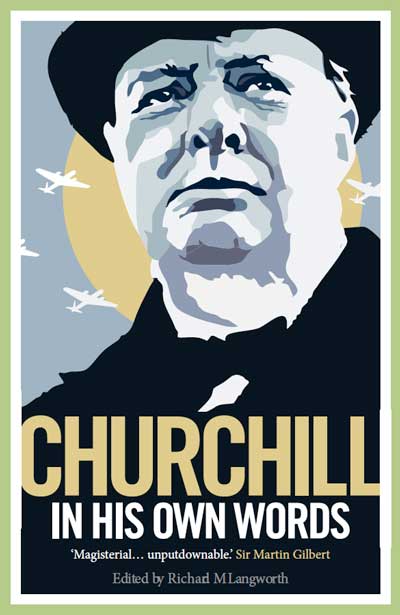
Can you please tell me who the artist is who created the lovely image of Winston Churchill on your book Churchill by Himself?  —M.D., London With pleasure. He is Richard Deane Taylor, who painted the original for a Collier’s cover in 1951 after Churchill had returned to Downing Street following the General Election. Click here [...]

Read the full article →