Posts tagged as:

BBC

I’m currently analysing a few of Churchill’s speeces for an academic paper. After listening to the audio files and reading along I found a lot of paragraphs which were left out in the radio speeches. It’s especially evident in “Their Finest Hour” from June 18th, 1940 where only a fifth of the text made it to the radio. At one point it sounds like the audio file has been edited. Were the audio files full radio speeches or just excerpts? —N.K., Copenhagen

What you are listening to is likely a postwar recording of speeches Churchill made for HMV/Decca, which were edited and truncated in later versions. However, the June 18th speech was rebroadcast in full by Churchill that evening over the BBC.

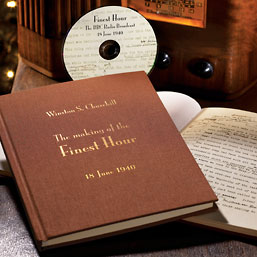
Levenger’s book, The Making of the Finest Hour, includes a CD containing the full broadcast. But many Churchill Speech CDs, and LPs before them, contained only excerpts. Some of these were taken from the BBC broadcasts, but most were recorded by Churchill years later.

No recordings were permitted in the House of Commons at that time, leaving us with two inferior possibilities: Churchill’s broadcast speeches over the BBC, or in some cases postwar recordings, both of which—said those who heard them in the Commons—lack the fire of the originals.

See Sir Robert Rhodes James, “Leading Churchill Myths: ‘An Actor Read
His Speeches over the Wireless,’”
Finest Hour 92, posted on the Churchill Centre website.

Sir Robert noted: ‘Problems then arise from the records, Harold Nicolson lamenting that it was necessary to bully Churchill into broadcasting, and, referring to a June 18th broadcast, “he just sulked and read his House of Commons speech over again.” Nicolson was Information Minister at the time. Churchill never liked broadcasting, but there is no evidence whatever that he was replaced by anyone, and speech researchers have confirmed this.’


{ 2 comments }

Brendan Gleeson as WSC. (Photo by Susan Allnutt for HBO.))

Brendan Gleeson as WSC. (Susan Allnutt for HBO)

“Into the Storm,” a television drama broadcast by the BBC and HBO, produced by Ridley Scott, directed by Thaddeus O’Sullivan, with Brendan Gleeson as Winston Churchill and Janet McTeer as Clementine Churchill. Screenplay by Hugh Whitemore.

Then out spake brave Horatius,
The Captain of the Gate:
“To every man upon this earth
Death cometh soon or late.
And how can man die better
Than facing fearful odds,
For the ashes of his fathers,
And the temples of his gods…”

—“Horatius,” stanza XXVII in Lays of Ancient Rome, by Thomas Babbington Macaulay. Recited at the beginning and at the end of “Into the Storm.”

Here is a TV docudrama packing exceptional honesty. An old man, at an age when most men retire (or in his time die), is handed command of his nation, when no one else wants it, in the greatest crisis of her history. They fight alone, save for their kith and kin, “the old lion and her lion cubs,” as he put it, “against hunters who are armed with deadly weapons.” And they win—only to see the old man dismissed in the moment of victory.

The opening scene is Hendaye, France, July 1945, where Churchill, his wife and daughter Mary spend a week’s break between polling-day in the British General Election and the start of the Potsdam Conference. Anxious for election returns (delayed for a fortnight to count the service vote) Churchill relives the past five years in a series of flashbacks. This is the film’s one jarring element: the back-and-forth occurs without obvious transition, and you have to remind yourself whether you are in the past or present. It is the only fault worth noting. The story is massive, the action real, the history honest, the dialogue convincing, the scenes artful, the acting superb.

Brendan Gleeson, who in life speaks with a heavy Irish brogue, is the best Churchill since Robert Hardy. He falls into none of the usual traps. Most Churchill impersonators overdo the accent or the famous lisp, the V-sign or toilet scenes or siren suits, the caricatures painted by Lord Moran or Alanbrooke. Gleeson’s work was praised by WSC’s daughter Lady Soames, the sternest of critics.

Hugh Whitemore, the sensitive scriptwriter of Scott’s preceding film, “The Gathering Storm,” has again helped by not loading the dialogue with soaring rhetoric. “Papa spoke in private,” his daughter says, “much as he did in public.” And here is the private Churchill, with doubts about winning, fears of the future, and faults of his own—for he was as human as anyone, freely admitted it, and often apologized for it, especially to his wife.

Several quotes, though real enough, are taken out of time or context, but Whitemore blends them flawlessly into the story, and the student of Churchill’s words doesn’t mind. Several scenes—the famous “naked encounter” with Roosevelt is one—didn’t happen that way, but are so seamlessly integrated and well acted as to make them believable and acceptable. Churchill’s habits—like the mandatory siesta which enabled him to work into the wee hours—are deftly conveyed in a line of dialogue. There is no bending of history for the sake of drama. Only the advanced pedant can object to the film’s artistic license.

Yalta, 1954: Gleeson, Cariou, Patrenko (HBO).

Yalta, 1945: Gleeson, Cariou, Patrenko (HBO).

Janet McTeer is no Vanessa Redgrave, the archetypal Clementine in “The Gathering Storm.” She doesn’t even look like Clemmie, falling short of the character described by her daughter Mary’s biography. Though she gives WSC good advice, she seems more of a neurotic scold than a pillar of strength. It doesn’t matter because Gleeson, “throws himself into the character and completely owns him,” as Daniel Carlson writes, “from the nonstop cigars to the famous cadence of his speeches. Gleeson is believably tough but doesn’t make Churchill a warmonger or bully; if anything, he’s burdened by the thought of the boys he has sent to die.”

Carlson has his finger on the outstanding quality of this film: its sensitivity to Churchill’s true persona. Despite many opportunities for ignorant political posturing—the leveling of German cities, for example—Scott and Whitemore always have Churchill saying what he truly believed—culled in this case from My Early Life (1930): “War, which used to be cruel and magnificent, has now become cruel and squalid.”

”Into the Storm” packs less depth than “The Gathering Storm”—like the persecution of Ralph Wigram for sending WSC secret reports on German rearmament, and the bravery of his wife Ava during threats against their family. But too much is going on for sidebars. This is World War II, remember: the French debacleDunkirk, the Battle of Britain, the BlitzPearl HarborSingapore, the fraught meetings with Roosevelt (Len Cariou) and Stalin (Alexy Patrenko), the all-or-nothing assault on Normandy. Leadership is the plot, sub-plot and sidebar.

Some Churchillians have asked why Ridley Scott couldn’t have stopped at Pearl Harbor, and done a third film later; why there couldn’t be multiple parts; why it wasn’t a Churchill version of “Lord of the Rings.” Indeed, I criticized “The Gathering Storm” for skipping over Neville Chamberlain and Munich. But the best editor I ever worked for said: “A bore is someone who tells everything.” And we are not filmmakers. We have no idea what constraints the producers labored under. We do know that Ridley Scott had ninety minutes. And what he does to portray the real Winston Churchill is a work of genius. 

My enduring impression of “Into the Storm” is of an old man, realizing after the most heroic chapter in his country’s history that history itself has passed him by, the Britain he loved vanished before his eyes. “The palmy days of Queen Victoria and a settled world order,” as Churchill put it in 1947, are gone forever. The war is won, the country lost in a Socialist dream. Hardly, alas, unfamiliar: a signal message in 2009.

A lot of us who grew up in Churchill’s time feel the way Churchill does at the end of this film, as he reads a sympathetic post-election note from his old friend Jack Seely: “I feel our world slipping away.” Churchill thinks back: “I met him in South Africa, riding across the veldt. He was Col. Seely then. I saw him at the head of a column of British cavalry, riding twenty yards in front, on a black horse. I thought of him as the very symbol of Imperial power.”

Watching this film, I had the odd sensation that it was well Britain chose World War II for what John Charmley called “The End of Glory.” British power and faith, focused one last time by a leader steeped in history and language, held the fort “till those who hitherto had been half blind were half ready.” Better to go out in a flash of light than face the long decline that seems now to attend another superpower. “The proud American will go down into his slavery without a fight,” Pravda (astonishingly) declared, “beating his chest and proclaiming to the world how free he really is.” That will take years. For Britain the End of Glory came in months.

“Yes, I’ve worked very hard and achieved a great deal,” Churchill reflected at the end of his long life, “only to achieve nothing in the end.” A life that rose to the heights of fame, the honors of the world showered upon him—for what? “I feel,” he said, “like an aeroplane at the end of its flight, in the dusk, with the petrol running out, in search of a safe landing.”

Not only he.

{ 1 comment }