Did Churchill Praise Hitler?
The film “Judgment at Nuremberg” suggests that Churchill offered praise to Hitler right after the Munich Pact, which would seem an odd time for Churchill to be singing the praise of the Führer. What’s the story? —K.C., Washington
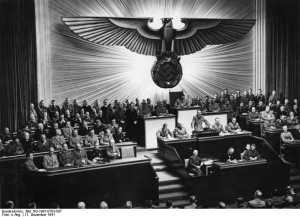
In a speech to the Reichstag in early November 1938, Hitler had attacked Churchill and others who had objected to the Munich Pact by name and describing them as “warmongers.” Replying in the House of Commons on 6 November, Churchill said:
I am surprised that the head of a great State should set himself to attack British members of Parliament who hold no official position and who are not even the leaders of parties. Such action on his part can only enhance any influence they may have, because their fellow-countrymen have long been able to form their own opinion about them and really do not need foreign guidance.
What Churchill then said has often been quoted out of context to suggest that he was an admirer of Hitler. A partial quotation is in Churchill by Himself, the “People” chapter, Hitler, page 346. But just so there’s no doubt, I have supplied all the words represented by ellipses in my book:
I have always said that if Great Britain were defeated in war I hoped we should find a Hitler to lead us back to our rightful position among the nations. I am sorry, however, that he has not been mellowed by the great success that has attended him. The whole world would rejoice to see the Hitler of peace and tolerance, and nothing would adorn his name in world history so much as acts of magnanimity and of mercy and of pity to the forlorn and friendless, to the weak and poor.
Since he has been good enough to give me his advice I venture to return the compliment. Herr Hitler also showed himself unduly sensitive about suggestions that there may be other opinions in Germany besides his own. It would be indeed astonishing if, among 80,000,000 of people so varying in origin, creed, interest, and condition, there should be only one pattern of thought. It would not be natural: it is incredible. That he has the power, and, alas! the will, to suppress all inconvenient opinions is no doubt true. It would be much wiser to relax a little, and not try to frighten people out of their wits for expressing honest doubt and divergences. He is mistaken in thinking that I do not see Germans of the Nazi regime when they come to this country. On the contrary, only this year I have seen, at their request, Herr Bohle, Herr Henlein, and the Gauleiter of Danzig, and they all know that.
In common with most English men and women, I should like nothing better than to see a great, happy, peaceful Germany in the vanguard of Europe. Let this great man search his own heart and conscience before he accuses anyone of being a warmonger. The whole peoples of the British Empire and the French Republic earnestly desire to dwell in peace side by side with the German nation. But they are also resolved to put themselves in a position to defend their rights and long-established civilizations. They do not mean to be in anybody’s power. If Herr Hitler’s eye falls upon these words I trust he will accept them in the spirit of candour in which they are uttered.
14 thoughts on “Did Churchill Praise Hitler?”
Thanks for clarifying Churchill’s statement. That one always bugged me since I heard it in Judgement at Nuremberg.
Churchill was no angel, but that particular comment always seemed out of character.
(To Mr. Balls, below):
I think you are a little confused. You have certainly confused me—and taken me out of context.
1) My statement (in a reply below) was: “What Churchill incorrectly called ‘poison gas’ was tear gas” is clearly linked to my description of the gas he considered using in Iraq in 1921.
2) In that article, “O’Reilly, Churchill and Poison Gas,” I then move on to Churchill’s query about use of gas in 1943, and quote Sir Maritn Gilbert: “But the military experts to whom Churchill remitted the question doubted whether gas, of the essentially non-lethal kind envisaged by Churchill, could have a decisive effect, and no gas raids were made.” (Gilbert, Churchill: A Life, 783.)
You then offer two Churchill memos, one of which you misdate, which you say prove Sir Martin Gilbert was “lying” or “conflating,” because (you say), they are in reference to “Normandy alone.” Not so. In 1943 Churchill was trying to think of contingencies that might arise in the coming invasion. In May 1944 he was indeed thinking of Normandy. But by July 1944 the invasion was a month old, and he was thinking of the rest of the war.
3) The PM’s Personal Minute (“On July 6 I asked for…”) was dated July 25th, not July 6th. (How indeed could it be?) Churchill asks about mustard gas (which is miserable stuff but far less lethal than chlorine or phosgene). Gilbert himself quotes this minute (Road to Victory 1941-1945), page 865. Gilbert adds:
“In fact, unknown to Churchill, the Vice-Chiefs of Staff, meeting on July 13, had considered Churchill’s minute, and instructed the enquiry into ‘the question of employing gas against Germany’ to be made by the Joint Planning Staff….Equally unknown to Churchill, the enquiry had been put in train on July 16, so that when the Chiefs of Staff met on July 26 to consider Churchill’s second minute, they were able to provide their report, not ‘within three days’ as he had asked, but within a few hours. In its first eight and a half pages, the report argued against the use of gas.”
4) PM’s Personal Minute (“I want a cold-blooded calculation”) is quoted in Gilbert, Road to Victory, page 776. You correctly state that this was in relation to the coming Normandy invasion. However, a far more specific “cold blooded calculation” request by Churchill was dated July 6th, a month after the invasion. It—and not his May 21st message—is in fact the memo Churchill refers to on July 25th (above).
Both Gilbert (Road to Victory, 840-41) and Hillsdale’s Churchill Documents (Volume 20), quote this memo completely. Your excerpt is from one of seven numbered paragraphs on use of gas—not only in Normandy, but in the ongoing march to Berlin. Again Gilbert records the reaction:
“On July 8 the Chiefs of Staff Committee, at its morning meeting with Brooke presiding, discussed what the minutes described as Churchill’s request ‘that a comprehensive examination be made of the question of employing gas against Germany’. Portal, the only member of the Chiefs of Staff to speak on this issue, said that he was ‘not convinced’ that the use of gas would produce the results suggested in Churchill’s minute. ‘It was very difficult’, Portal told the meeting, ‘to achieve a heavy concentration of gas over a large area’, nor did he believe that the use of gas against launching sites ‘would stop flying bomb attacks.'”
So I am left perplexed as to how, correctly and chronologically interpreted, any of these memos can be considered contradictory, misrepresentative, conflated, misleading, or something Martin Gilbert lied about. Together they represent Churchill’s consistent concern, in World War II, that Britain be prepared to retaliate in kind to any use of any gas by the enemy. They never did; and Britain never did. But to win wars, one has to be prepared.
“What Churchill incorrectly called “poison gas” was tear gas” – Langworth
“But the military experts to whom Churchill remitted the question doubted whether gas, of the essentially non-lethal kind envisaged by Churchill, could have a decisive effect, and no gas raids were made.”
– Sir Martin Gilbert [as quoted by Langworth]
Sir Martin was lying, as well as—if you’ve quoted him correctly—conflating texts from entirely separate documents. I posses photos I took personally of the documents I quote here.
“On July 6 I asked for a dispassionate report on the military aspects of threatening to use lethal and corrosive gases on the enemy if they did not stop the use of indiscriminate weapons. I now request this report within three days.”
—Prime Minister’a WPersonal Minute, Serial D.217/4. July 6, 1944. UK NA: CAB 120-775.
Churchill’s reference to mustard gas in this memo was for use in Normandy alone.
“I want a cold-blooded calculation made as to how it would pay us to use poison gas, by which I mean principally mustard. We will want to gain more ground in Normandy so as not to be cooped up in a small area. We could probably deliver 20 tons to their 1 and for the sake of the 1 they would bring their bomber aircraft into the area against our superiority, thus paying a heavy toll.
“I do not myself believe that the Germans will use gas on the beaches, although this is the most potent way in which gas could be used….General Montgomery tells me that he is leaving all his anti-gas equipment on this side and his men are not even to carry gas masks. I agree with this.”
—Prime Minister’s Personal Minute, Serial D.163/4. May 21, 1944. Ibid.
Not only the Lusitania. Why, he also sank the Titanic! Not only chemical weapons in Russia. He also wanted to gas the Iraqis! And he singlehandedly engineered the Bengal Famine. Did you know he knew about Pearl Harbor in advance and kept mum? Let the tumbrels roll!
Churchill was a war criminal. He should have been tried for putting war munitions on passenger liners like RMS Lusitania, and for using chemical weapons in Russia.
Publish it? Why not? It’s a free country, and everyone has the right to embarrass themselves.
Let me get this straight. Anxious to promote my flawed vision, I edited out a comment by the real Sergio (whom “Lord Marlborough” says I misled below), and substituted a fake Sergio, writing only positive things. Aside from the limited hours in the day, I suppose I could do this. But WordPress has this annoying habit of identifying one’s ISP, and would slap my name on it. This may scare you: WordPress knows who you are.
Churchill said: “He spoke without a note, and almost without a point.” At least “Lord Marlborough” made some points. So I have to ask if you have any, other than to push the Vulgarity Meter. There’s a limit to that, even in a democracy.
N.B.: Interesting that most messages like this come from people who use screen names, while those with adult observations often fully identify themselves—like Mr. Sergio Asuncion (below) who will get a copy.
I am not holding my breath for you to publish this. But I will go through the motion:
A certain Sergio referred to by the article’s author, and by another reader (so-called Lord Marlborough -for lack of a better namesake-), appears to have waded in Winston Churchill and threw some ‘punches’.
However, his post is nowhere to be seen. It must have been removed. Interestingly, while the original Sergio has been edited out of opposition to the article (how democratic, sir), an impostor Sergio appears to have eaten his words and seen the ‘light’.
Talking about having your cake and eating it. I wouldn’t bother suggesting to you telling you to take your hypocritical democracy and shove it up a certain part of your rear anatomy, but I think that I just did.
Long may your exemplary wisdom and tolerance of any opinion that does not run contrary to your flawed vision continue.
By gad, your Lordship, I think you’re on to something! Thanks for quoting your favorite part from my original post….
Indeed I only just today quoted those words (and many others) in the Hitler chapters for my next book, Churchill and the Avoidable War, on the 1930s. (The questions: Was he right or wrong? Was World War II preventable? The answers, respectively, will be: “both” and “yes, but with great difficulty.”)
The problem is, the one-two punches you offer Sergio are not Churchill’s first and last comments on Hitler, but something like his 37th and 75th; and separated by three years—from 1935 (when Hitler was preaching peace and harmony) to 1938 (after Hitler had grabbed the Rhineland, Austria, and Czechoslovakia). A letter Hitler wrote Lord Rothermere, in May 1935, except for the white supremacy bits, could have been written by the Pope. One must consider what happened in between.
Not only did Churchill “let his tongue rattle away,” he never censored a word. He left a million-document archive, published 15 million words in books, articles, speeches and papers—oodles of grub for those with preconceived notions to extract exactly what they need to prove he was “a wicked old poltroon.” (You can say that; I couldn’t possibly comment.)
I am not going to leak my book because I fully expect you to buy the e-book for £1 and make me 70p richer—and then write another furious letter. But I will quote my first paragraph of Chapter 2, “Germany Armed”:
“Churchill’s critics have used his writings to argue that he was ‘for Hitler before he was against him.’ In an abstract sense, Churchill did admire Hitler’s dominating political skill and nerve. With his innate optimism he even hoped briefly that Hitler might mellow. But in his fundamental understanding Churchill, unlike most of his contemporaries, never wavered. He was right all along: dead right.”
N.B. Saddam Hussein used more than mustard gas, reliable authorities suggest: nerve gas, perhaps cyanide. What Churchill incorrectly called “poison gas” was tear gas; mustard gas, while pretty rough, was not Saddam’s complete recipe. And if you’re going to quote the rude things Churchill said about Gandhi, you might consider what Gandhi said about Churchill—after the India Bill had passed and Churchill had urged him to “make the thing a success.”
Sadly Sergio, you have been misled on here. You were initially correct to assume that Winston Churchill had uttered words of praise for Adolf Hitler. And here they are:
“One may dislike Hitler’s system and yet admire his patriotic achievement. If our country were defeated, I hope we should find a champion as indomitable to restore our courage and lead us back to our place among the nations.” – Winston Churchill ‘Hitler and His Choice’ (originally 1935)
He was provisional enough to repeat himself whilst adding a paragraph or two in order to play up to being taken out of context at a later date. The politician’s favourite excuse: “My words have been taken out of context.”.
Churchill’s second emission relating to Hitler, his tidied up version replete with provisional get out clause (context) reads as:
“I have always said that if Great Britain were defeated in war I hoped we should find a Hitler to lead us back to our rightful position among the nations. I am sorry, however, that he has not been mellowed by the great success that has attended him. The whole world would rejoice to see the Hitler of peace and tolerance, and nothing would adorn his name in world history so much as acts of magnanimity and of mercy and of pity to the forlorn and friendless, to the weak and poor. … Let this great man search his own heart and conscience before he accuses anyone of being a warmonger.” – ‘Mr. Churchill’s Reply,” House of Commons, 6Nov38
I wouldn’t rest on these two separate quotes as being any sort of defining factor on the character of Winston Churchill. In truth he has let his tongue rattle away on so many occasions oft shocking those listening with his scant regard for humanity and he shocked even more whilst writing with no audience to impress, such as when he was president of the air council in 1919, he wrote:
“I do not understand the squeamishness about the use of gas. I am strongly in favour of using poisonous gas against uncivilised tribes.”
A few years later mustard gas was used against the Kurds. A crime Saddam Hussein was hung for.
However, his distaste for the “uncivilised” didn’t stop there. He branded Gandhi “a half-naked fakir” who “ought to be laid, bound hand and foot, at the gates of Delhi and then trampled on by an enormous elephant with the new viceroy seated on its back”.
And there’s plenty more occasions recorded throughout history where this wicked old poltroon allowed his true person to be revealed.
Not at all, it’s quite accurate, and you correctly include Churchill’s words usually excised by spin artists. But he said that about Mussolini, not Hitler.
Your quote is from Churchill’s press statement in Rome (20 January 1927) after meeting with Count Volpi, Italy’s finance minister, over the Italian war debt (Churchill was then Chancellor of the Exchequer), and after two brief meetings with Mussolini. You tend to say polite things about a nation’s leader when you want him to cough up the money his country owes yours.
I reproduced this quotation in Churchill By Himself, with the following note: “The first words of this passage have often been extracted from the rest to suggest that Churchill approved of Fascism. As the context shows, what he approved of was Italy not falling to Bolshevism, which he then feared more than anything. The remark is redolent of his usual courtliness to foreign hosts. As the years passed and circumstances changed, his view of Fascism darkened.”
Churchill was even more loquacious in praise of Mussolini in his desperate letter urging him not to enter the war in 1940, when France was collapsing. You tend to say disarming things when you are trying to encourage a fellow not to stab you in the back. After Musso did that, he want from “law-giver” to “whipped jackal” in the Churchill lexicon.
Was Churchill impressed by the Mussolini of 1927? Quite possibly. A lot of people were. Fortunately Churchill never redacted a thing from his archives, where we can pore over a million documents, along with 15 million published words, finding exactly what we want. (See next communication.)
This was probably out of context too, eh?
“I could not help being charmed, like so many other people have been, by his gentle and simple bearing and by his calm, detached poise in spite of so many burdens. If I had been an Italian, I am sure that I should have been whole-heartedly with you from start to finish in your triumphant struggle against the bestial appetites and passions of Leninism. But in England we have not yet had to face this danger in the same deadly form…But that we shall succeed in grappling with Communism and choking the life out of it – of that I am absolutely sure.”
You recall wrong. The Gathering Storm, London:Cassell, 1948, page 43:
“These months in the Landsberg fortress were however sufficient to enable him to complete in outline Mein Kampf, a treatise on his political philosophy inscribed to the dead of the recent Putsch. When eventually he came to power there was no book which deserved more careful study from the rulers, political and military, of the Allied Powers. All was there – the programme of German resurrection, the technique of party propaganda; the plan for combating Marxism; the concept of a National-Socialist State; the rightful position of Germany at the summit of the world. Here was the new Koran of faith and war: turgid, verbose, shapeless, but pregnant with its message.”
The quote supplied still isn’t complete. If I recall, Churchill praised Mein Kampf immediately before the the segment the author of this website supplied.
Thank you very much for the clarification! Since I watched the aforementioned movie, I had taken for granted Churchill had really praised Hitler in an early time. Adding that to his seeming support to eugenic policies led me to think he was ideologically close to the Nazis’ own sinister point of view.However, the text shows that, on the contrary, Churchill asked Hitler to take into consideration the German people’s diverse opinions and to be gentle with the less fortunate ones.