Black Swans Thrive at Churchill’s Chartwell
1935….
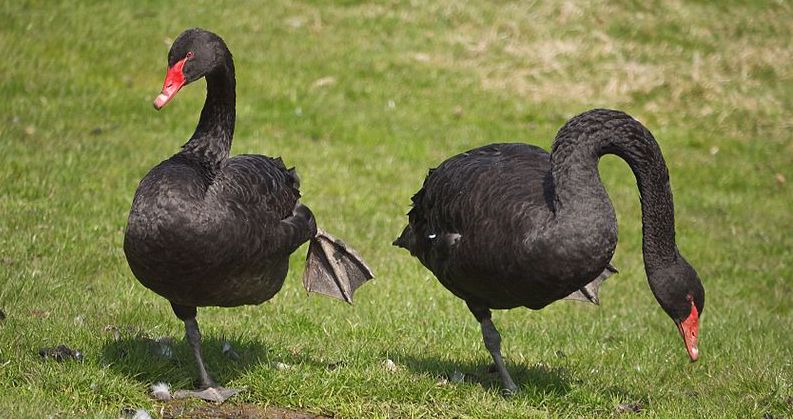
“All the black swans are mating, not only the father and mother, but both brothers and both sisters have paired off. The Ptolemys always did this and Cleopatra was the result. At any rate I have not thought it my duty to interfere.” —Churchill to his wife, Chartwell, 21 January 1935.
Return of the swans
(Updated from 2009). Visiting Chartwell in 1935, Lady Diana Cooper observed its collection of birds. There were “five foolish geese, five furious black swans, two ruddy sheldrakes, two white swans—Mr. Juno and Mrs. Jupiter, so called because they got the sexes wrong to begin with, two Canada geese (‘Lord and Lady Beaverbrook’) and some miscellaneous ducks.”
Chartwell’s black swans were looked after as zealously as the apes on Gibraltar. But marauding foxes and mink had reduced the population to zero by 2008.
Happily in 2009, Chartwell head gardener Giles Palmer installed a new floating “swan island” to provide natural protection, and two new black swans (Cygnus atratus) were returned to the ponds designed by Churchill himself.
Mr. Palmer told Kent News:
I have seen the swans on their island once or twice. I am confident they will be there as soon as the foliage grows up. For now, I’m simply thrilled that the swans are settling on so well. They’re getting so brave now that they venture all the way to the kitchen garden.
The floating island has allowed Palmer to remove ugly mesh screening set up against predators, returning the lakes to their appearance in Churchill’s time.
The first black swans
The original black swans were a gift to Churchill from Sir Phillip Sassoon in 1927. The population was frequently topped up by the government of Western Australia, where they are the state symbol. C. atratus is native also to Tasmania and has been introduced to New Zealand. It is the world’s only black swan, though its flight feathers, invisible at rest, are white.
Talking to the animals
Churchill was devoted to his swans and regularly engaged them in “swan-talk,” in which he claimed proficiency. But a postwar bodyguard, Ronald Golding, told me his skill was not exclusive. It was one of WSC’s little myths. In fact, the swans would cry out to anyone who approached within a certain distance. Ron said:
Some time after this discovery that I was walking down to the lake with Mr. Churchill. I was a little in front, and watched carefully for the critical spot. I then called out in “swan-talk” and the birds dutifully replied to me.
Mr. Churchill stopped dead. I turned round and he looked me full in the eye for a moment or two. Then the faintest suspicion of a smile appeared and he walked on in silence. No comment was ever made that this secret was shared.
Related reading
“‘Darling Monster’: Lady Diana Cooper and Her Remembrances of Churchill,” 2022.
“Lady Diana Cooper on Winston and Clementine,” 2018.
“Churchill’s Butterflies Continue to Flourish at Chartwell,” 2019.